

Friday E-dition: When Stagecoaches Ruled the Mount St. Helena Road
By Kathleen Scavone

Summary: Kathleen Scavone uses a childhood drive over the mountain between Napa and Lake counties to frame a history of the stage routes that once tied Calistoga to Clear Lake towns and resorts. Drawing on local histories, she traces how stage lines carried mail, freight and tourists to hot springs while drivers built reputations on narrow, punishing roads. The piece highlights standout reinsmen, including Clark Foss and William Spiers, and the risks that came with hauling bullion and payroll through sparsely populated mining country. By the 1910s, Scavone writes, the automobile began pushing stage travel toward its end.

“History isn’t about dates and places and wars. It’s about the people who fill the spaces between them.” ― Jodi Picoult, The Storyteller
When Stagecoaches Ruled the Mount St. Helena Road
By Kathleen Scavone
NAPA AND LAKE COUNTIES, Calif. — Driving the mountain roads in Lake and Napa counties takes some getting used to. Once I counted 93 turns along Highway 29 between Calistoga and Middletown. As a kid, my parents drove me and my three seatbelt-less siblings over the mountain from Anaheim to our grandmother’s home in Upper Lake for a visit. As we swayed and rolled into one another in the 1958 Ford station wagon, I couldn’t get enough of the wild evergreen and oak canopy that we were driving under. It was magical; and the forest remains so to me today. Imagine traversing that same mountain in the 1800s to early 1900s!
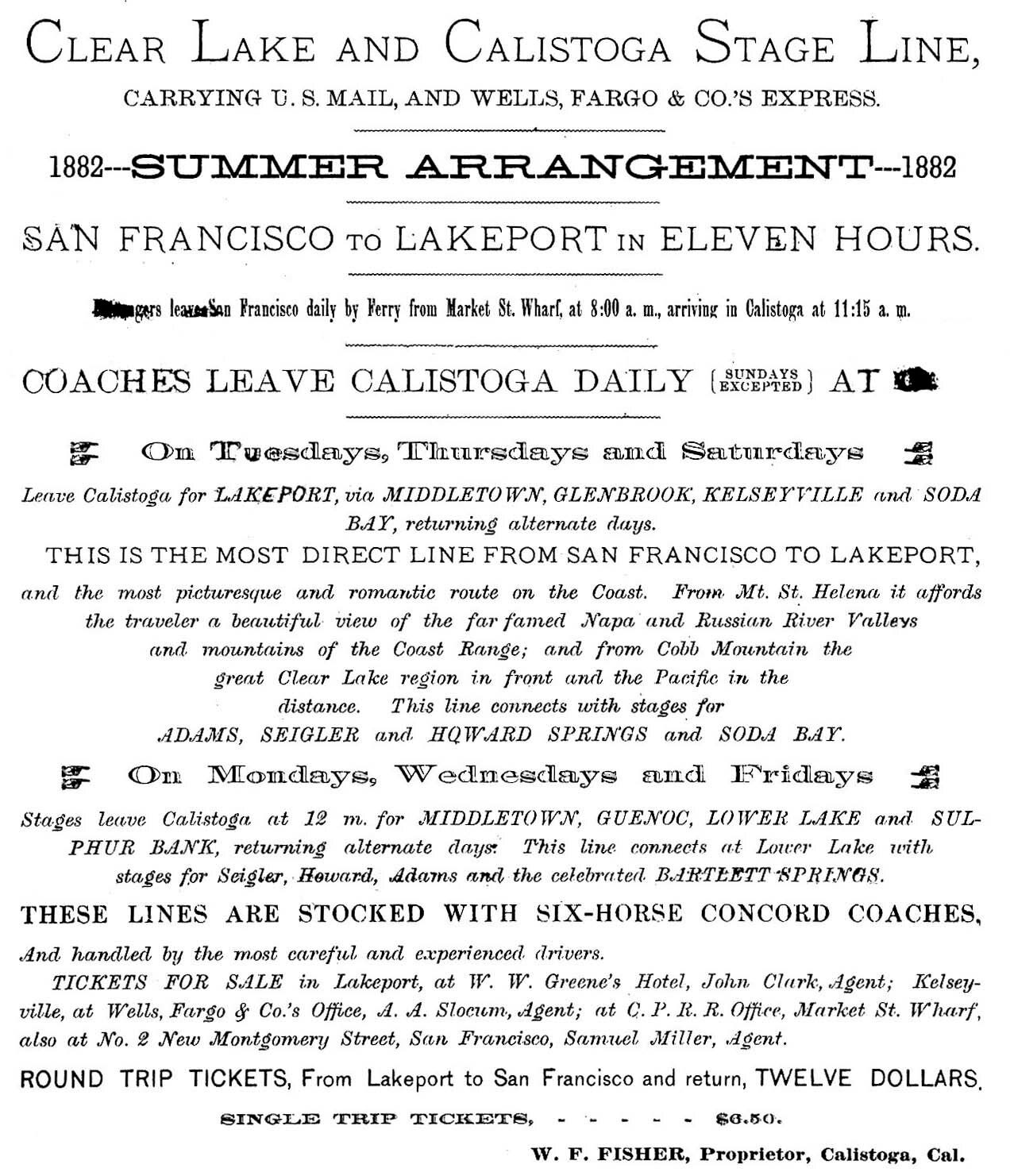
The book titled “History of Lake County 1881,” published that year by Slocum, Bowen & Co., explains the vital transportation link over Mount St. Helena and vicinity as follows: “Lower Lake is connected with the outside world by two stage lines, one extending from East Lake to Calistoga, and the other from Lower Lake to Woodland. The mail service has been heretofore daily for some time, but is at present only tri-weekly.”
Ken Stanton’s comprehensive book, “Mount St. Helena & R.L. Stevenson State Park: A History and Guide,” reminds us of the hunting and fishing offered in the Napa Valley in the 1840s when 10 grizzlies could be shot in a single hunt, salmon clogged the Napa River and elk grazed the green grasses of the valleys. Appropriately naming it an Eden, this time of great numbers of game such as elk and other ungulates or cloven-hoofed mammals began to dwindle after the Gold Rush of 1849 as more and more settlers took refuge in the Napa Valley and its mountains.

Transportation via stage travel was a vital link for travelers from San Francisco to the many hot springs resorts that were popular in Napa and Lake Counties. The bubbling mineral springs such as Lake County’s Adams, Seigler and Howard hot springs all touted health benefits and fun for vacationers. Freight wagons were hitched to four- and six-horse teams while passenger coaches were hauled with six- and eight-horse teams leading travelers and vacationers up the mountain.
The stagecoach drivers, or reinsmen, of the early days included William Fisher, who was an agent for the Nathan Coombs Stage Line running from Benicia and Napa in 1857. As time went by his stage line ran between Healdsburg and Calistoga, and later he started the Clear Lake and Calistoga Stage Line.
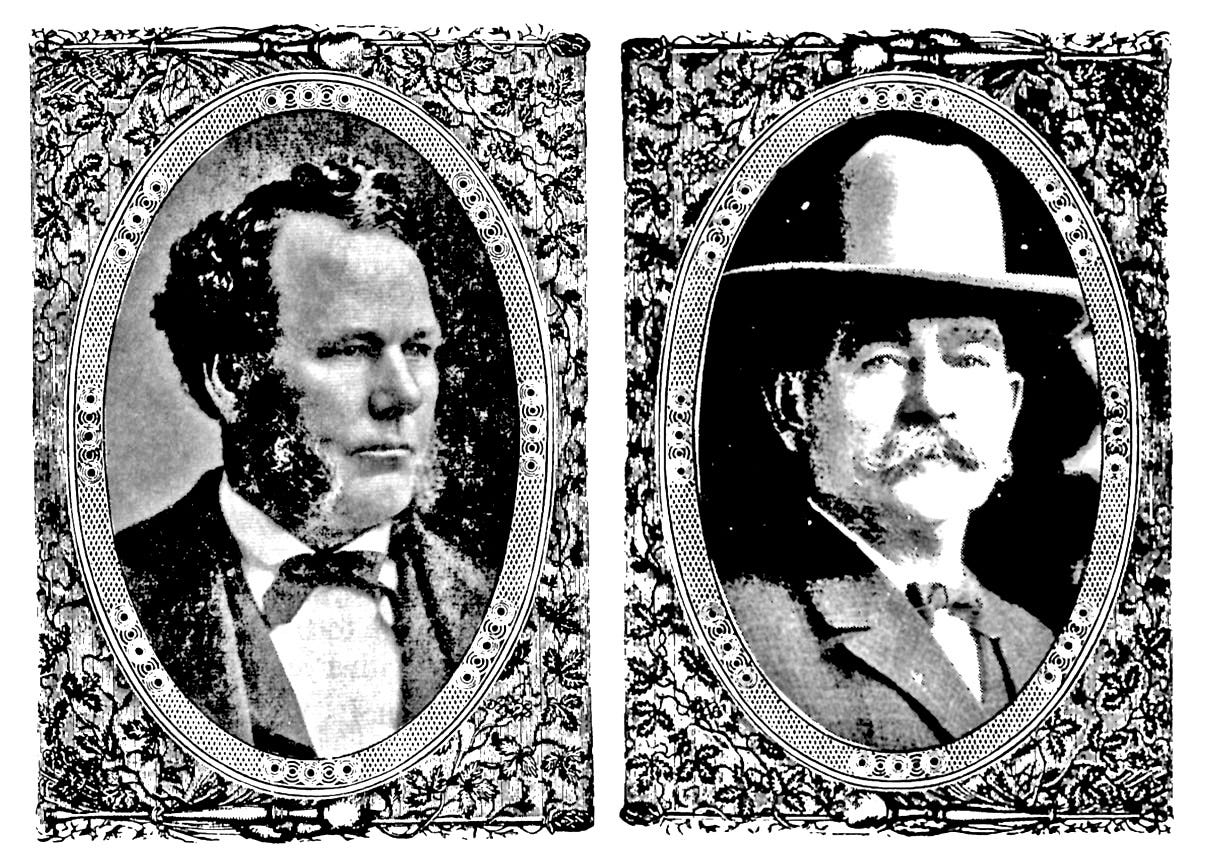
Clark Foss was renowned for his trips to the Geysers Hot Springs Resorts when they drew thousands of guests between 1855 and 1875. Foss lived at the western foot of Mount St. Helena at Fossville. He became even more famous after an article about his adventurous stagecoach rides was published in Home and Abroad by Bayard Taylor in 1862, describing him as a giant of a man at 6 feet, 6 inches and 265 pounds and, “the best driver of his generation since he gave thrilling rides with nary an accident.”
Robert Louis Stevenson wrote about Foss in his book “The Silverado Squatters,” as well. Foss drove his team upon precarious and narrow roads at a high rate of speed. In about 1881, Foss’ good driving record ended as there was an accident that severely injured him and his seven passengers. He died in 1885, and his son took over the business until 1906.

William Spiers ran the Calistoga and Clear Lake Stage Line, hauling freight for the Great Western Mine, Oat Hill Mine and others in the late 1870s. The phrase “finest kind” was his answer to nearly any question regarding the country, his health or the weather. Spiers initially drove teams for Fisher. After Spiers pooled his earnings from work at the Pine Flat Mine in Sonoma County and a wood-cutting business he ran, he settled in Calistoga and purchased the stage line from Calistoga to Lake County’s resorts and towns.
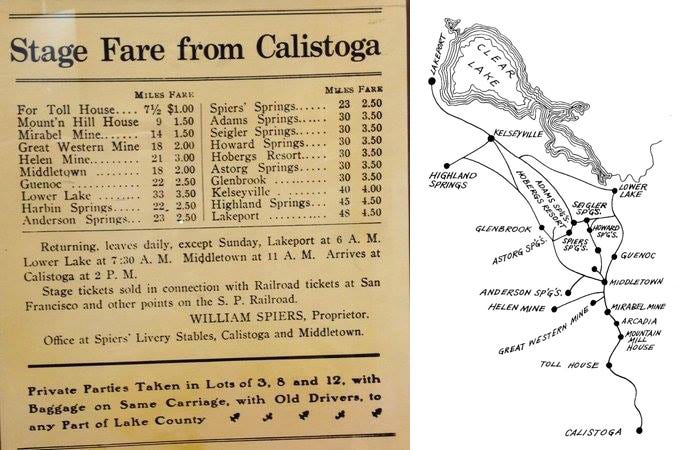
Stage fare from Calistoga, as noted in the news copy of the Office of Spiers’ Livery Stables (see Lake County Historical Society mini chart), was $2 to Middletown, $3.50 to Lower Lake and $4.50 to Lakeport. This mode of travel was thrilling, grueling and uncomfortable as it took riders across unpaved and jagged roads. Passengers were often crammed into the swaying, dusty coaches.
Spiers’ horses — up to 700 at one time — were outfitted with bells that were recognizable for miles around. Of his hundreds of horses, not all were put to work at one time since his shrewd business acumen led him to breed horse stock and run remount or relay stations as well as pull stagecoaches. His wife, Martha Simpson, or Mattie, ran the hotel and Calistoga stage stop and took care of the books. Since Spiers’ passengers were often wealthy folks and he hauled bullion and payroll from the mines, he was frequently robbed. He died after a heart attack in 1931 as he was driving his automobile in Calistoga. But it was around 1915 that stagecoach drivers like him understood that with the advent of the automobile their mode of transportation was coming to an end and they began to utilize autobuses.
The many other stagecoach drivers or reinsmen in the vicinity were Clarence Myers, Will Carter, Newt Connor, Bill and Joe Downey, Alan Palmer, E.B. Stoddard, H.T. Quigley and Johnny Gardner, who helped seize Buck English, one of the infamous highwaymen back in the 1880s. English was involved in petty thievery and larger misdeeds, such as robbing Chinese miners. (More about English and other highwaymen in a future article.)
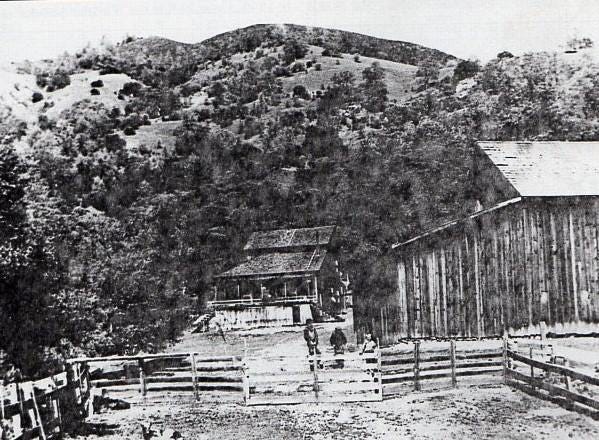
With relatively low populations, and a variety of silver, gold and mercury or quicksilver mines in the area, thieves (called highwaymen) were able to take advantage of stagecoach travel through numerous frequent robberies. Newspapers of the time would note, “Stage was robbed again today, at the usual place.”
The Sharpsteen Museum in Calistoga is where the Napa County Historical Society Facebook page says there is “…a William Spiers Stagecoach in front of his Livery Stable on Lincoln Avenue in Calistoga. Spiers started his stage line in 1880, driving travelers between Lake County and Calistoga. After the Calistoga Hotel was built in 1902 where the previously burned Magnolia Hotel stood, the Spiers Livery Stable would have been conveniently located for hotel guests.”
In Lake County, a trip through time at the Ely Stage Stop and Country Museum in Kelseyville is where visitors can get a close look at stagecoaches, old farm equipment and numerous old-timey paraphernalia.
—
Kathleen Scavone, M.A., retired educator, is a potter, freelance writer and author of “Anderson Marsh State Historic Park: A Walking History, Prehistory, Flora and Fauna Tour of a California State Park,” “People of the Water” and “Native Americans of Lake County.” She loves hiking, travel, photography and creating her single-panel cartoon, “Rupert.”
Today’s Polls:

Poem of the Day:
“The Stage Coach”
By George W. Doneghy
No matter what the weather was, in good old stage coach days,
The driver with his ruddy face and spanking team of bays
Would spin along the turnpike road, o'er level stretch and hill,
That wound away from "Idleburg" to classic Nicholasville.

The depths beneath his seat were filled with leathern sacks of mail,
And all the coach's top at times was crowded to the rail
With trunks, valises, packages, and bundles by the score,
That must have weighed, it seemed to me, five thousand pounds or more.

And strapped within the bulging boot, that hung far out behind,
Was added weight enough to make a team of oxen blind;
And counting all the passengers that filled the coach within,
The load those horses had to drag — I thought it was a sin!

How proud of them the driver was! And often he would brag
That they could pull a heavier load and never balk or flag;
If all the road was ankle-deep in miry, sticky mud,
That was the time his team would show its mettle and its blood.

The "ribbons" then he'd gather up, and give his whip a crack,
And any team in front of him had better clear the track;
He seemed to own the turnpike road, and kept the right of way
Unto himself as jealously as bloomers do to-day.

By wood and field he wound along, and by the river's bank,
And when he reached the covered bridge the hoof-beats on the plank
Were echoed from the cliffs around and from the vale below;
And going up the hill beyond he'd let 'em walk and blow.

Then urged into a trot again around the curves they spun
Till hove in sight the manor-house of Camp Dick Robinson;
And on beyond where Nelson lay, the bravest of the brave,
Till Nicholasville at last was reached, to them the reins he gave.

And when the sun was hanging low and slanting shadows fell,
Along the streets of "Idleburg" that old familiar yell
Would greet the ears of villagers from small boys as they ran
With open mouths and lusty lungs a-shouting "Here comes Sam!"

Ah me! The old stage coach, abandoned now, stands in the stable lot,
A victim to the tooth of rust, and slow decay and rot;
Its whole-souled driver years ago forever passed away,
And crumbled now to dust the hand that drove each gallant bay!
About the author: George W. Doneghy was a Kentucky poet whose work appeared in the late 19th century. His collection “The Old Hanging Fork and Other Poems” was published in 1897 and includes poems focused on rural life, local characters, work, travel and the changing landscape of the American South. His verse preserves details of everyday experiences that were familiar to readers of his era.
“The Stage Coach” is representative of Doneghy’s narrative style. Written in regular rhyme and meter, the poem celebrates the skill of the driver, the endurance of the horses and the importance of stage travel before the rise of modern transportation. Its closing lines reflect on the disappearance of the stagecoach and the passing of the people who made that way of life possible, turning a practical vehicle into a symbol of memory and historical change.
Are you a poet, or do you have a favorite piece of verse you’d like to share? Napa Valley Features invites you to submit your poems for consideration in this series. Email your submissions to napavalleyfeatures@gmail.com with the subject line: “Poem of the Day Submission.” Selected poets will receive a one-year paid subscription to Napa Valley Features (a $60 value). We can’t wait to hear from you.
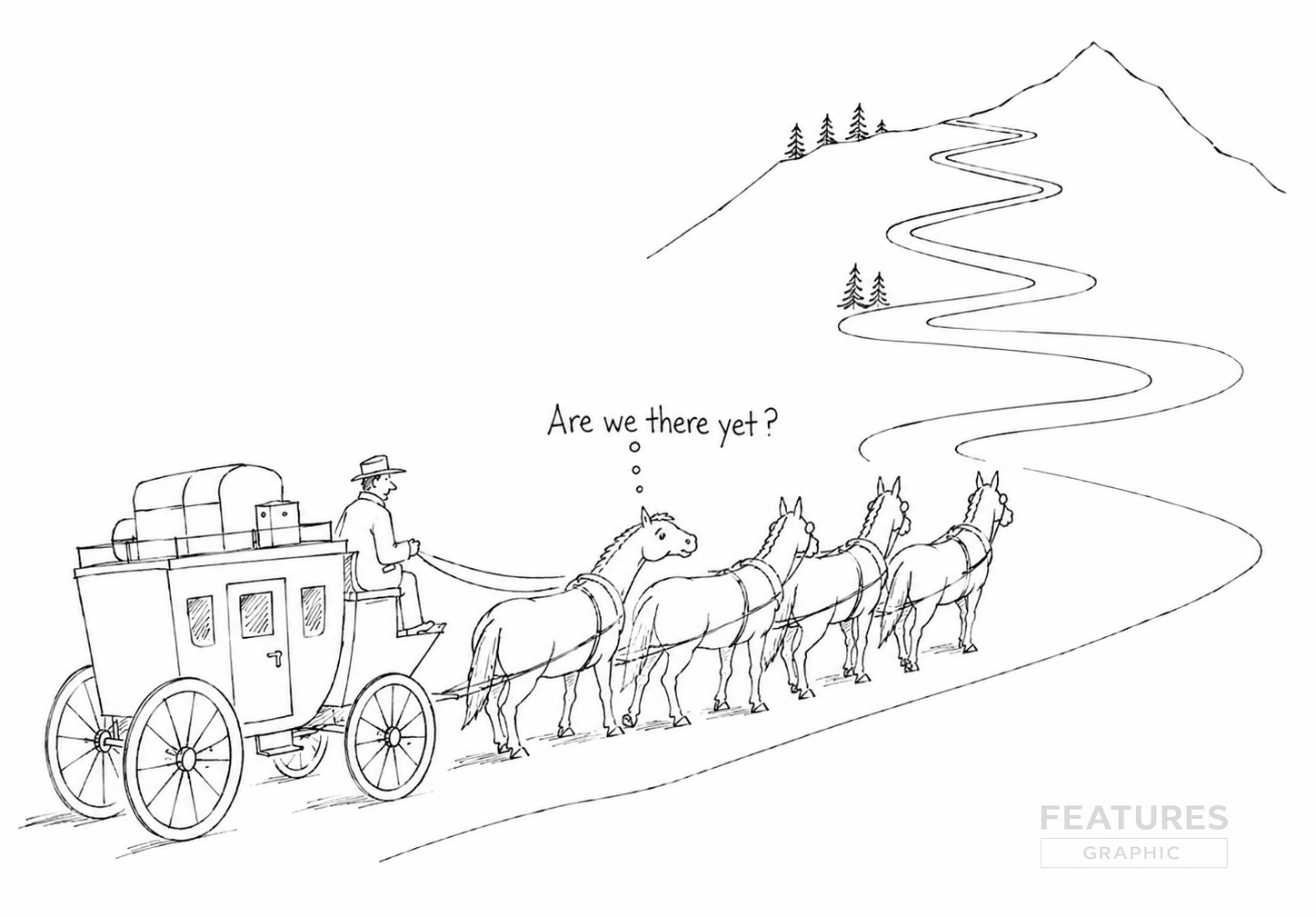
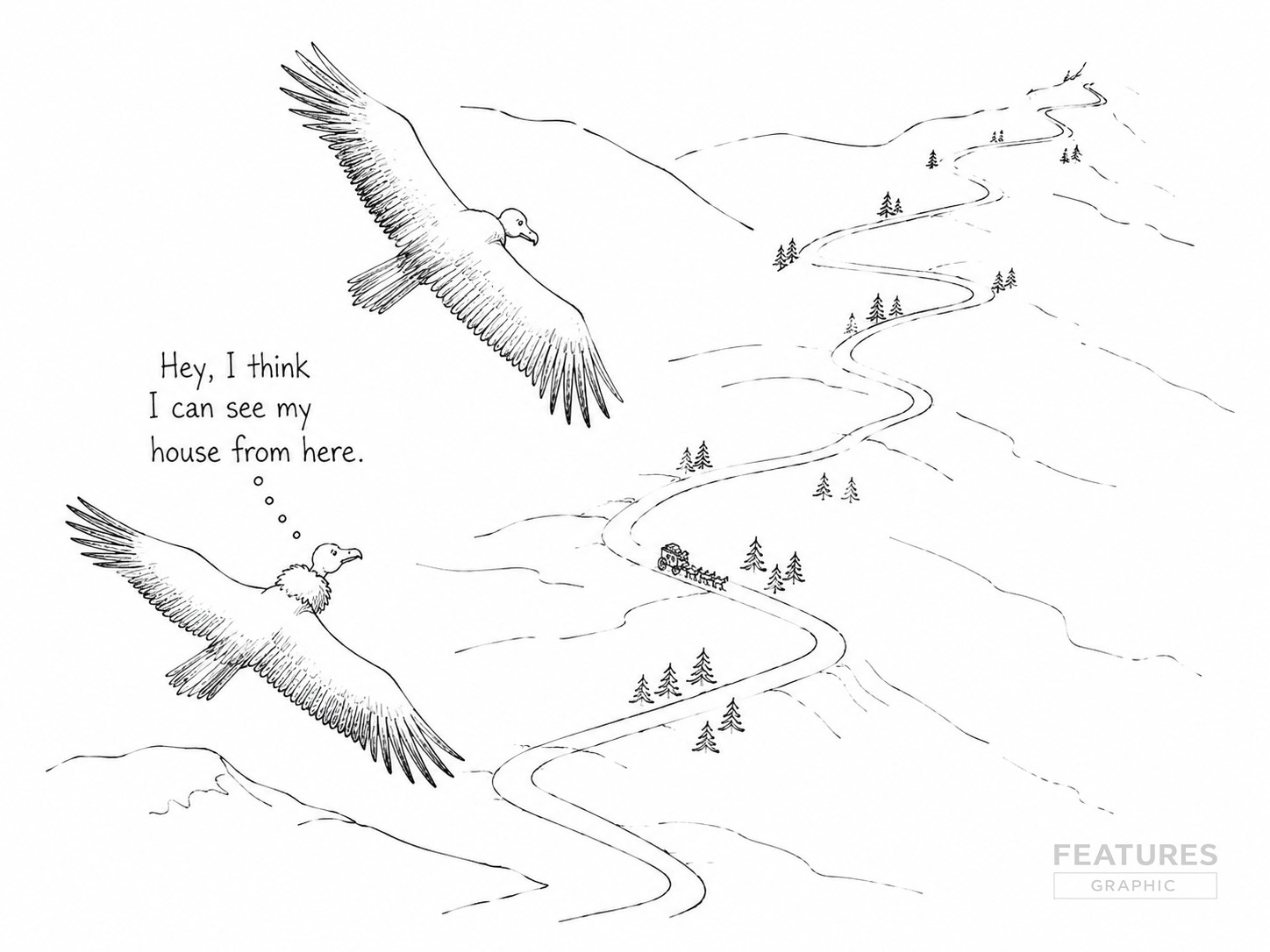
Today’s Caption Contest:
Pick your favorite caption or add your own in the comments below.

Possible Captions:
“Most of the problems are behind me now.”
“I’d rather not rely on instinct.”
“The old way wasn’t scalable.”
“The important thing is momentum.”
“Progress is difficult to argue with.”
Last Week’s Contest Results:
In “A Generation Comes Home to Tell Napa’s Other Story,” the winning caption was “The roots made a compelling case,” with 50% of the votes.

Caption Options:
The roots made a compelling case.
One thing led to another.
The internship never really ended.
The timing felt right.
The position has been filled.
Explore These Related Articles:


Browse All Napa Valley Features Stories
Browse All Sonoma County Features Stories
Browse All Lake County Features Stories
—
The views, opinions and data presented in this article are those of the author and do not necessarily reflect the official policy, position or perspective of Napa Valley Features or its editorial team. Any content provided by our authors is their own and is not intended to malign any group, organization, company or individual.
more than once, I went with my dad when he had a vet call to a place in the mountains between Calistoga/St Helena and Ronoma county. We often would see the remains of an old road for stage coaches coming into the farm. There is also one in the hills above Angwin coming from Lake County that a group of us saw. Wells Fargo had trips every where.