

Friday E-dition: After Grapes, A Path Back to Food Crops in Napa County
By Tim Carl

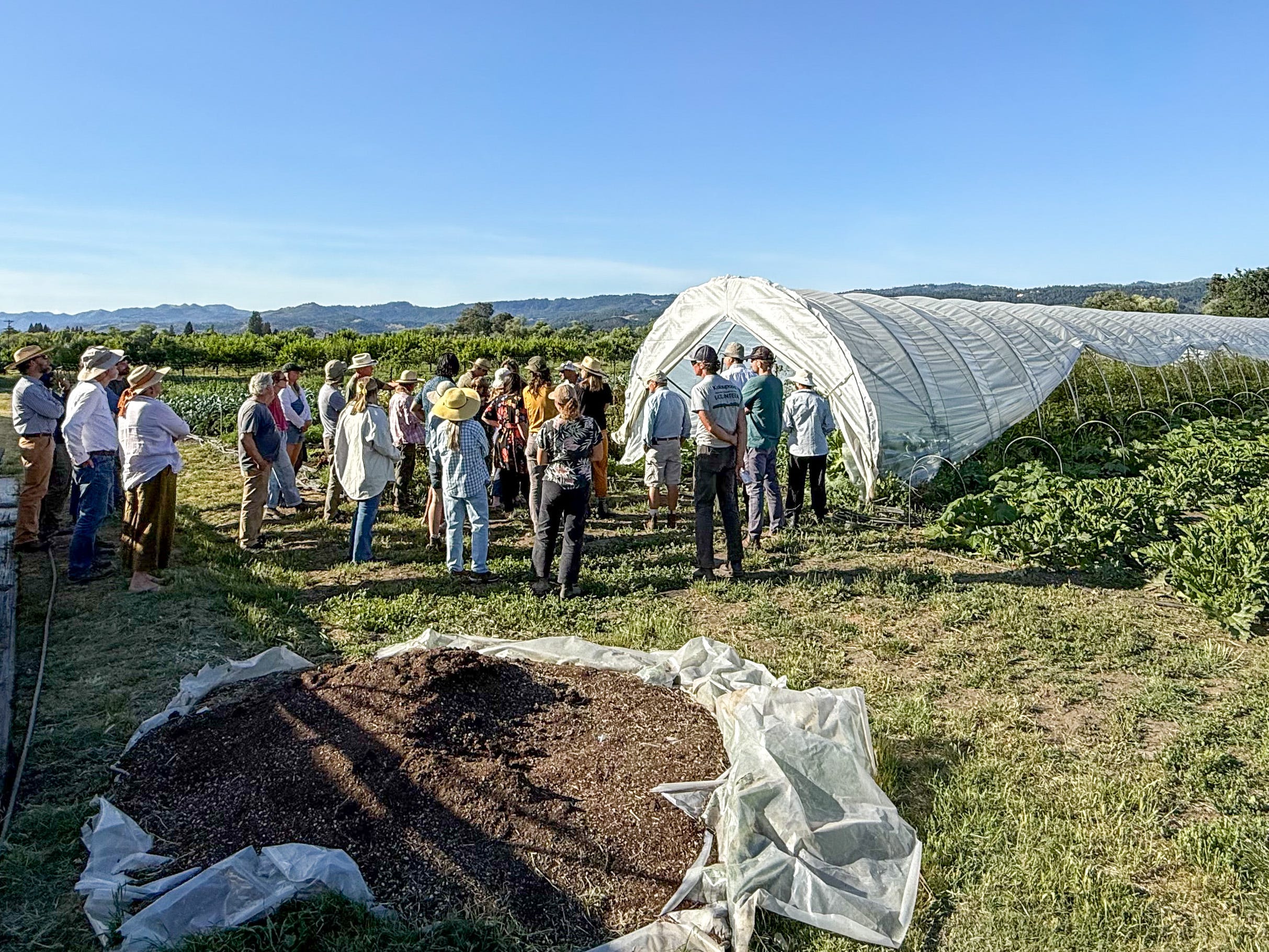
Summary: In late May, a Napa Farmers Guild gathering brought several dozen growers, organizers, conservationists and working farmers to a 6-acre culinary farm inside Long Meadow Ranch’s larger Rutherford Estate — a small pocket of diversified production surrounded by the estate’s organic vineyards and sitting directly across Highway 29 from Grgich Hills. Early in the afternoon, beekeeper Rob Keller told the group his colonies across the valley were emptying out in a way he had not seen before, with hives “absconding” rather than swarming. From there, the conversation moved through native pollinators, hedgerow habitat and soil biology, with farmers describing what they are already doing on small plots of land throughout the valley. By the end, the discussion kept circling a question older than the wine industry itself and one Napa’s longer agricultural history has answered more than once: What should working land in Napa Valley grow in place of the vineyards that are being removed?
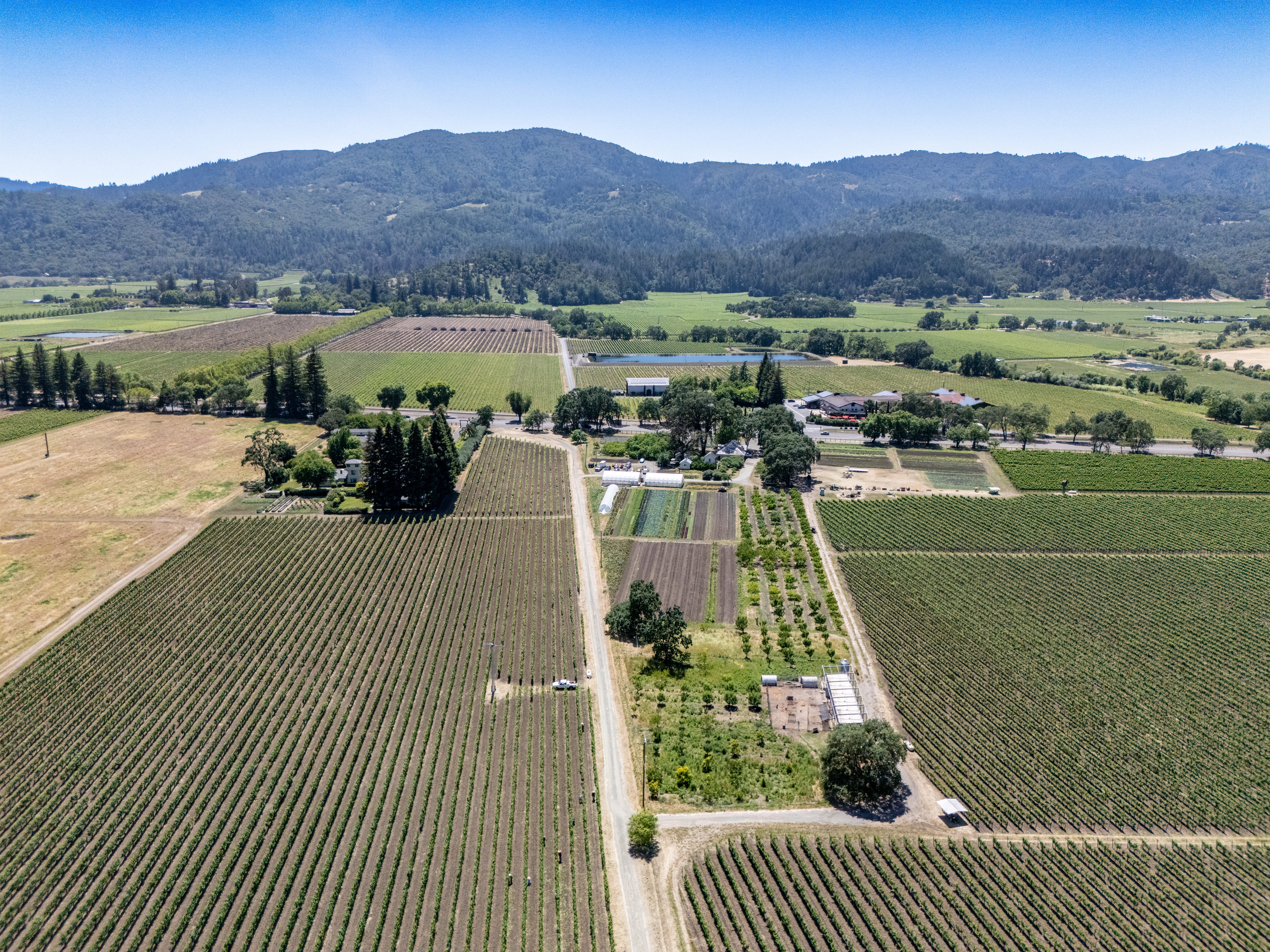
RUTHERFORD, Calif. — On a 6-acre sliver of farmland between Highway 29 and the Napa River, directly across the road from Grgich Hills Estate, a beekeeper was telling a small crowd that his hives were emptying out in a way he had not seen before.
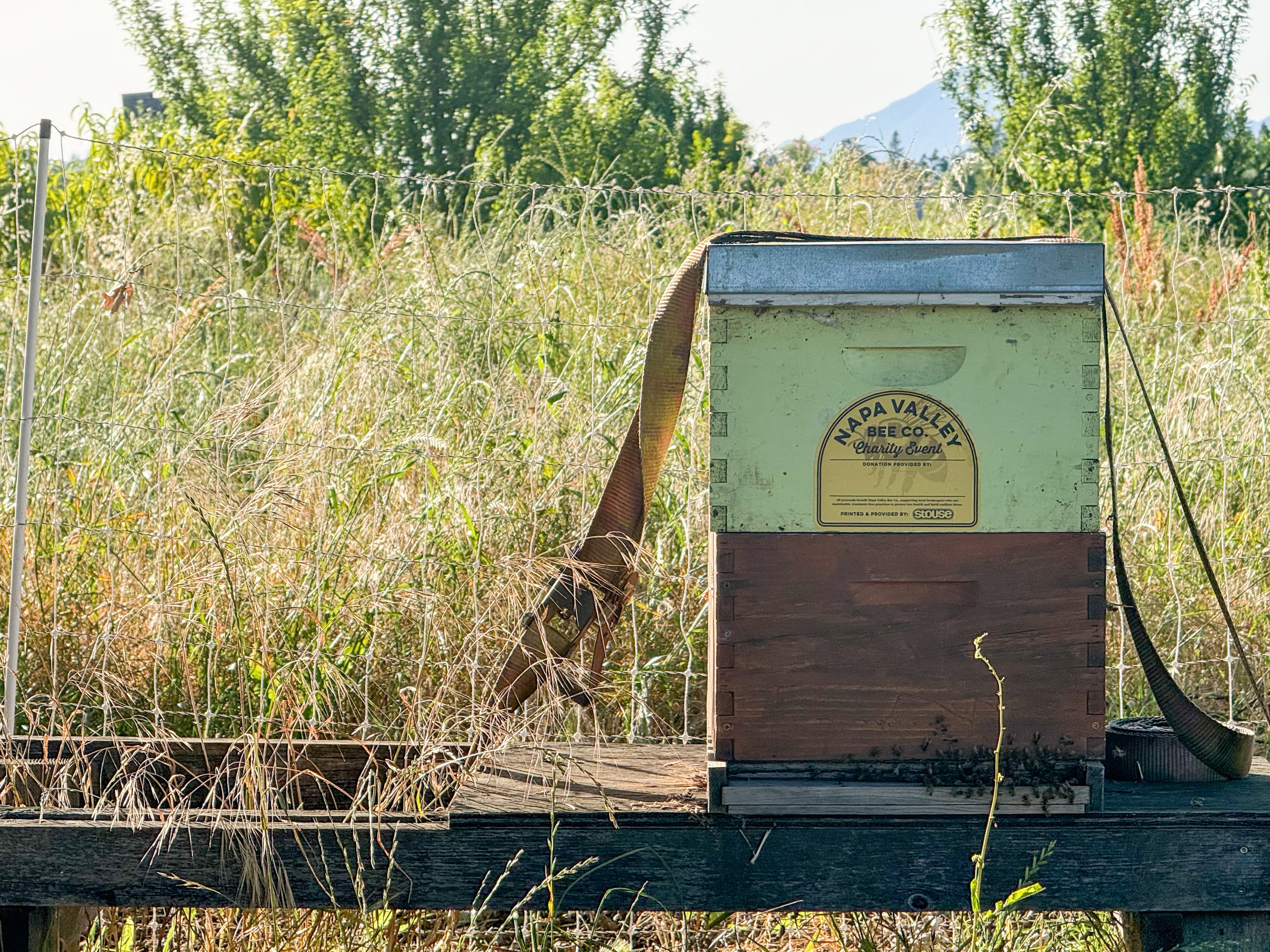
Rob Keller, who founded Napa Valley Bee Co. in the late 1990s and now manages roughly 100 colonies across the valley, said his bees were not swarming the way they normally do in spring. They were absconding — leaving without preparation, without a viable replacement queen, without the buildup of foragers at the hive entrance that usually signals a coming swarm. In hive after hive, he said, the queen had stopped laying about three weeks before the colony emptied. The last-ditch queen cells the workers left behind were smaller than usual, more pistachio than peanut.
“Talk to a beekeeper anywhere in the tri-county area, and they’re saying the numbers are way down,” Keller said. “So where did all these bees go?”
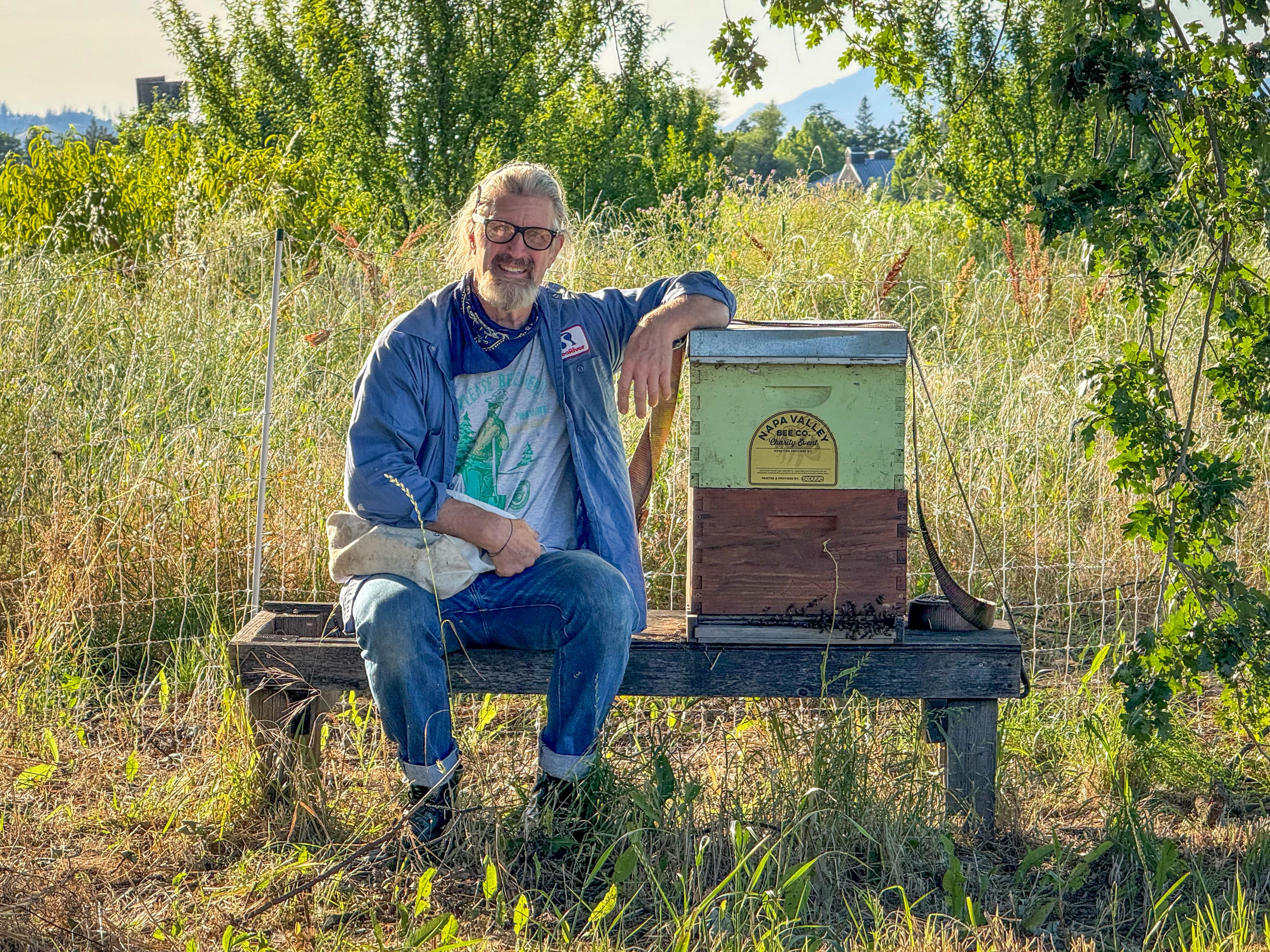
He had a theory but not an answer. Young queens, he said, may be leaving on their mating flights and not coming back. Steller’s jays could be taking some. The compounds Napa County’s own ag commissioner lists for vine mealybug control include systemic neonicotinoids — imidacloprid, clothianidin, thiamethoxam, dinotefuran — and spirotetramat, all of which can translocate into pollen and nectar where bees encounter them. Keller said pollen tests on his own hives have shown systemic fungicide residues consistent with what published research has documented in honeybee pollen samples from agricultural areas. He said he was preparing to feed colonies sugar water at a scale he had not used in years, and had already ordered his first 50-pound bag of sugar for the season. He has also been moving more of his hives under the shade of oak trees, a relatively recent change in his practice. The microclimate beneath an oak canopy, he said, has made a measurable difference in the bees’ ability to regulate hive temperature without burning through their workforce on water-gathering trips in Napa’s midday sun.
What Erin Arnsteen Means by Livestock
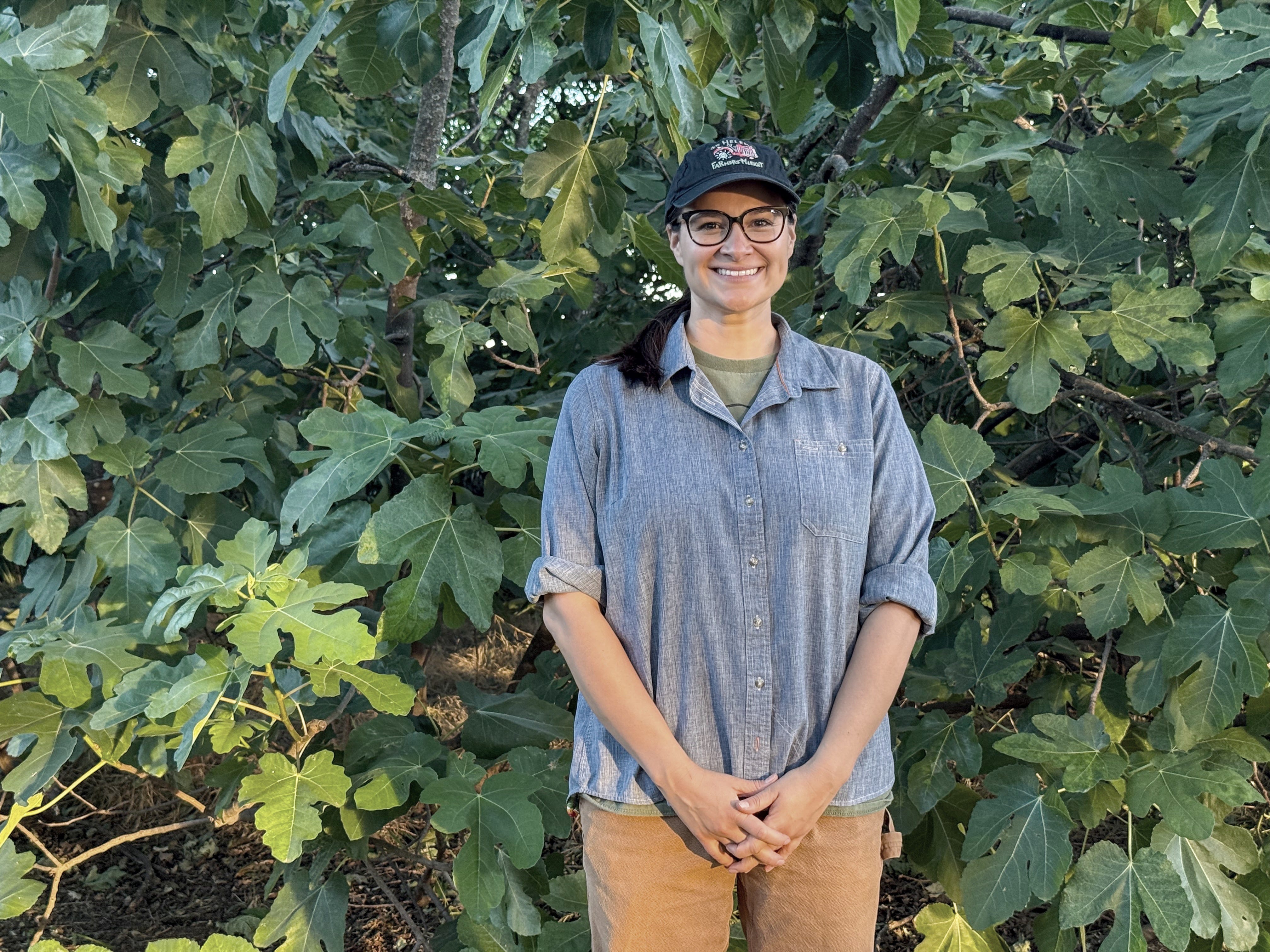
Erin Arnsteen, who works as western program coordinator for the Monarch Joint Venture and also volunteers with the Xerces Society, picked up where Keller left off and reframed the loss. Honeybees, she said, are livestock — useful, dependent on human management and not interchangeable with the wild bees upon which California depends. She cited a figure of nearly 1,600 native bee species in California, a number documented by the UC Berkeley Urban Bee Lab and used in the field guide “California Bees and Blooms” and said the wild populations are in worse shape than the managed ones.
“Getting a honeybee hive to save the bees is like getting a chicken coop to save wild migratory birds,” she said.
She is not making the argument in the abstract. The western monarch is the species she works on most closely, and the recent counts have been bleak. The Xerces Society’s 29th annual Western Monarch Count, released in January, tallied about 12,260 monarchs across 249 overwintering sites in late November 2025 — the third-lowest count since the survey began in 1997. The two lower years were 9,119 monarchs in the 2024 winter and 1,901 in 2020. The migratory western monarch population is estimated to have declined more than 95% since the 1980s.
The case Arnsteen makes for native habitat is not romantic. It is practical and stacked. Bunch grasses send roots deep enough to bring in beetles that eat aphids. Parasitoid wasps already present in the landscape will eat pest insects without intervention if there is somewhere for them to overwinter. Leaving stems and leaf litter through the cold months gives native bees and wasps the cavity nests and ground nests they need to complete their life cycles. Cut everything down in the fall and the next year’s pollinator population has nowhere to come back from.
In 2019, Arnsteen, her husband, Jess Arnsteen, and filmmaker David Garden co-founded the Western Monarch Society of Napa County. The group has since distributed more than 20,000 free milkweed starts to local gardeners, farmers and landowners — the kind of distributed habitat work that, in aggregate, is what western monarch recovery actually depends on. The Land Trust of Napa County has also planted about 1,000 milkweed plants at Sutro Ranch in eastern Napa County, as Natasha Mantle, a UC Master Gardener of Napa County, noted in “Green Wednesday: Monarch Conservation and Student Climate Leadership” (July 30, 2025). She made the connection explicit in her piece: California wineries reducing their grape acreage have an opportunity to plant pollinator-friendly flowers such as lavender, California natives and milkweed.
How This Farm Came to Be
Laddie Hall was at the gathering. She and her husband, Ted, moved from San Francisco to Napa Valley in 1989, when Ted left a senior partnership at McKinsey & Co. — he would later serve as chairman of the board at Robert Mondavi Winery and oversee the sale of that winery to Constellation Brands in 2004 — and Laddie was working as an Exploratorium docent and an after-school science teacher. They bought a 650-acre property in the Mayacamas Mountains that had been abandoned since Prohibition and gradually rehabilitated it, eventually planting 16 acres of organic vineyards on land first cultivated in the 1870s.
The farm that the Napa Farmers Guild met on did not begin with a farm plan. It began with their two young sons, Timothy and Chris, wanting to grow vegetables to sell at the local farmers market. The boys’ garden produced more than the family could use or sell, and the produce kept finding its way into other people’s kitchens. In 2010 the Halls opened Farmstead in an old St. Helena nursery barn. By the time the family consolidated the 90-acre Rutherford Estate in 2012 and 2013 — combining four parcels into one of the larger land holdings in the Rutherford AVA, 74 acres of certified organic vineyards alongside the culinary farm where the gathering took place — Farmstead was supplying more than 100,000 pounds of farm produce a year. None of it was the original plan. Hall spoke briefly to the group about how a kid’s interest in selling vegetables to the local market had set the rest of it in motion.
A 6-Acre Farm Inside a Wine Estate
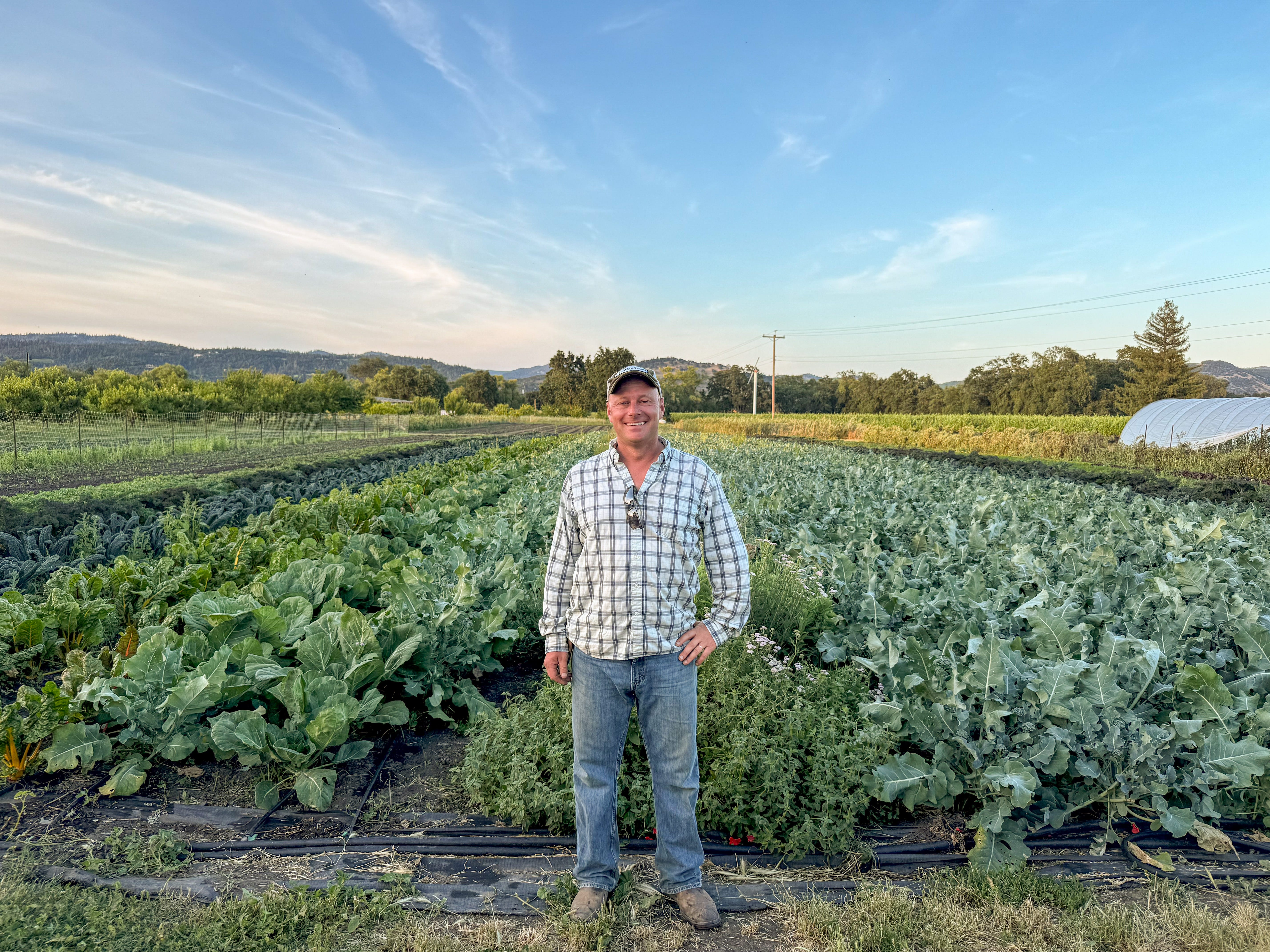
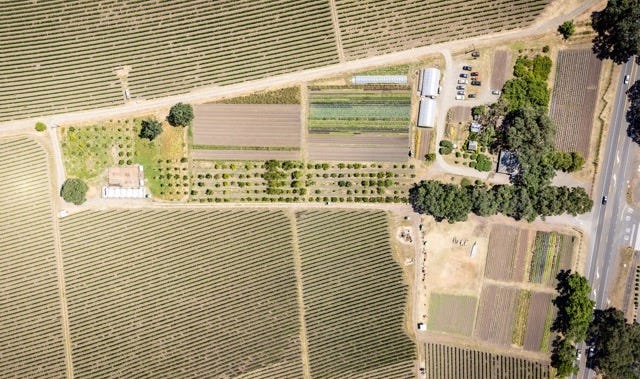
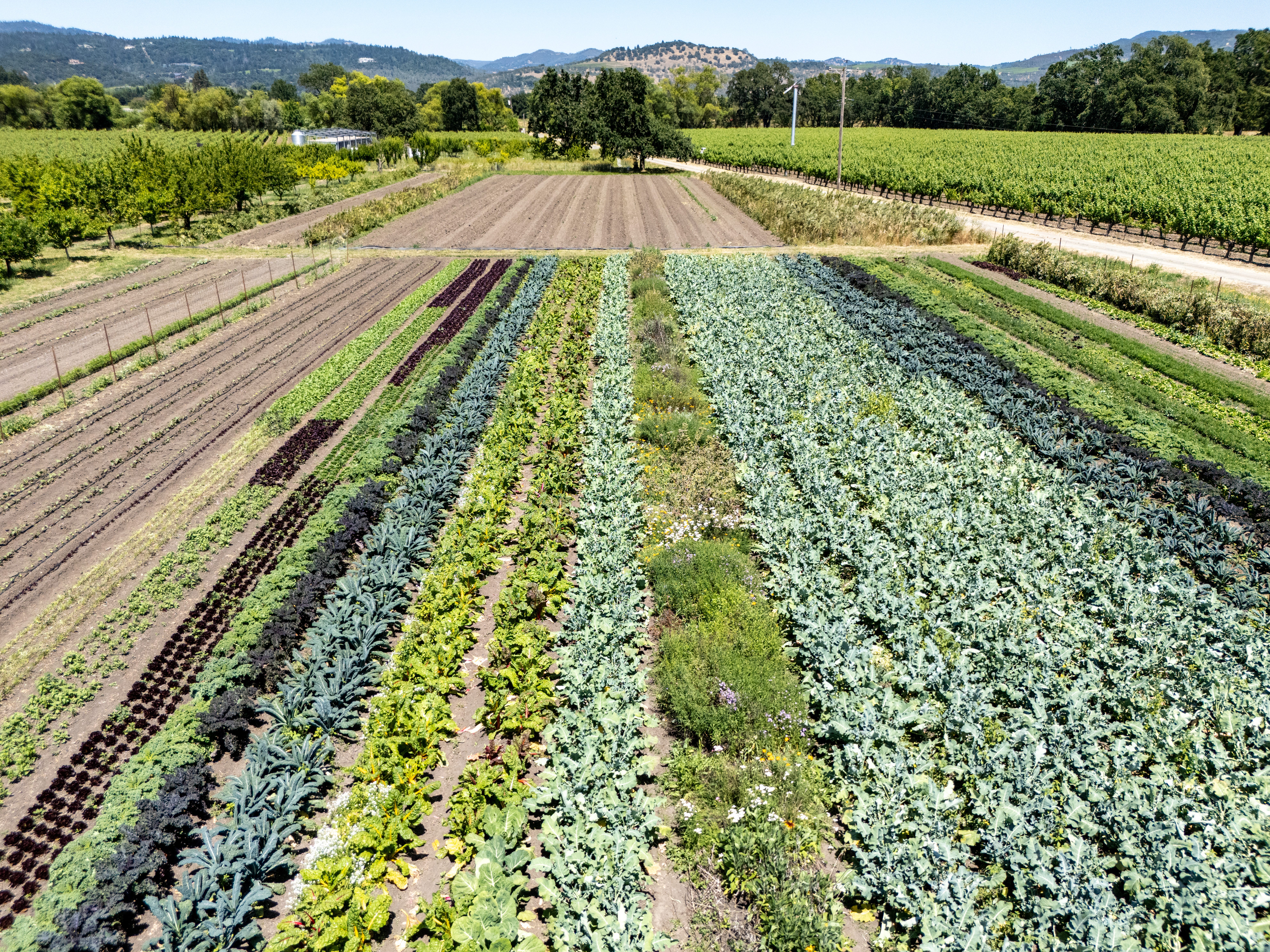
Jess Arnsteen oversees about 12 acres of fruit, vegetable and egg production across two parcels for Long Meadow Ranch: roughly 6 acres at the Rutherford Estate, where the gathering took place, and roughly 4 acres up the valley behind the Farmstead restaurant in St. Helena. The culinary land at Rutherford has never been planted to grapes. It sits surrounded by the estate’s 74 acres of certified organic vineyards planted to sauvignon blanc, cabernet sauvignon and merlot, and its crops feed Farmstead and four farmers markets — Friday in St. Helena, Saturday in Napa, Sunday in Sausalito and Tuesday in Napa from March through December.
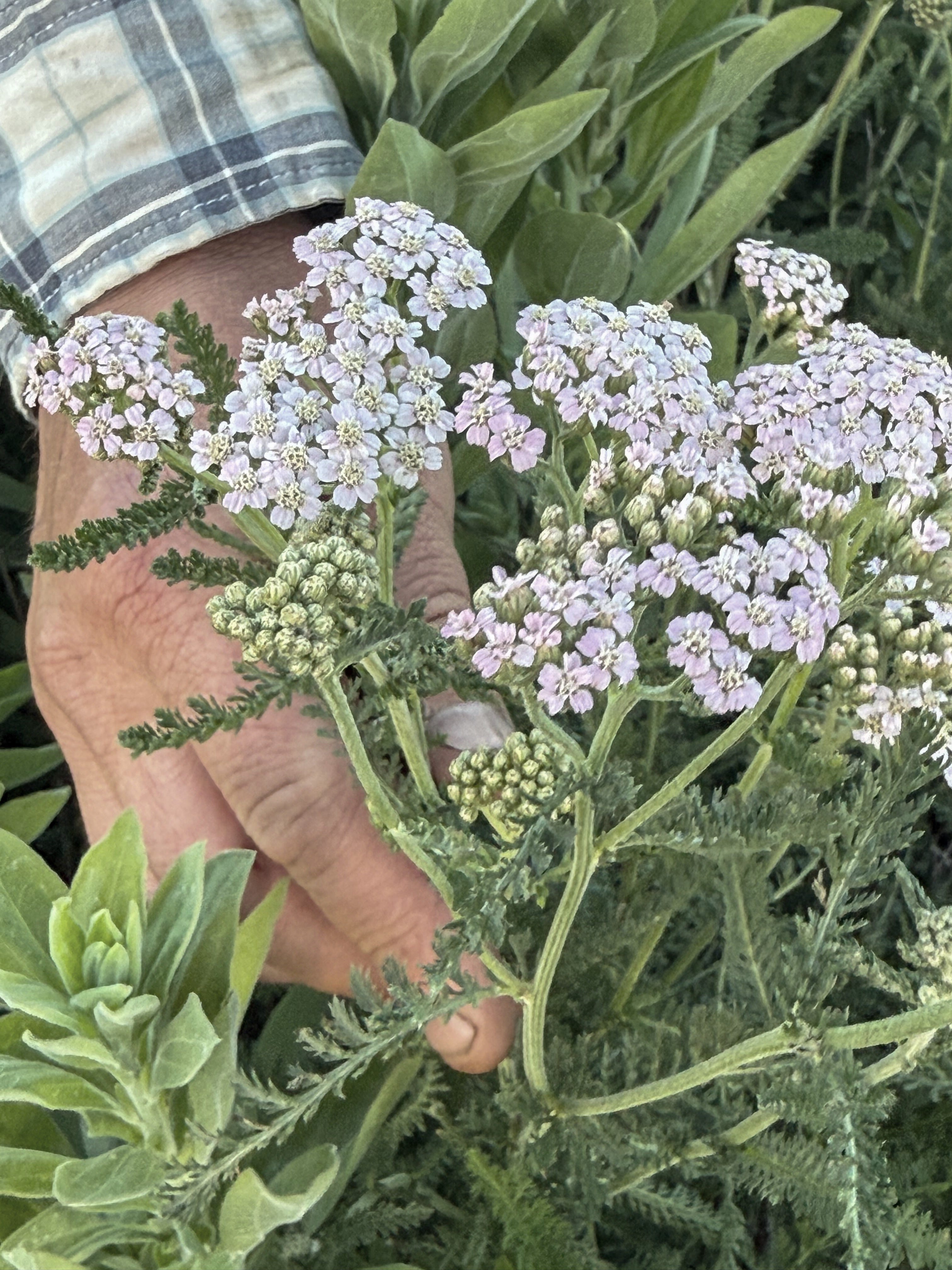
Between two crop blocks, Arnsteen has planted a 200-foot native plant hedgerow that he intends to extend by another 200 feet this season. It is the kind of feature most visitors would walk past without noticing — coyote mint, yarrow, goldenrod, narrow-leaf milkweed, two species of phacelia, Pacific aster — but it is doing a particular job. Arnsteen pointed to the adjacent broccoli, which showed no aphid pressure and no caterpillar damage.
“I don’t spray,” he said. “It’s easier for me and better for me to plant this habitat and observe it and watch it and enjoy it than to run around chasing things with chemicals or oils.”
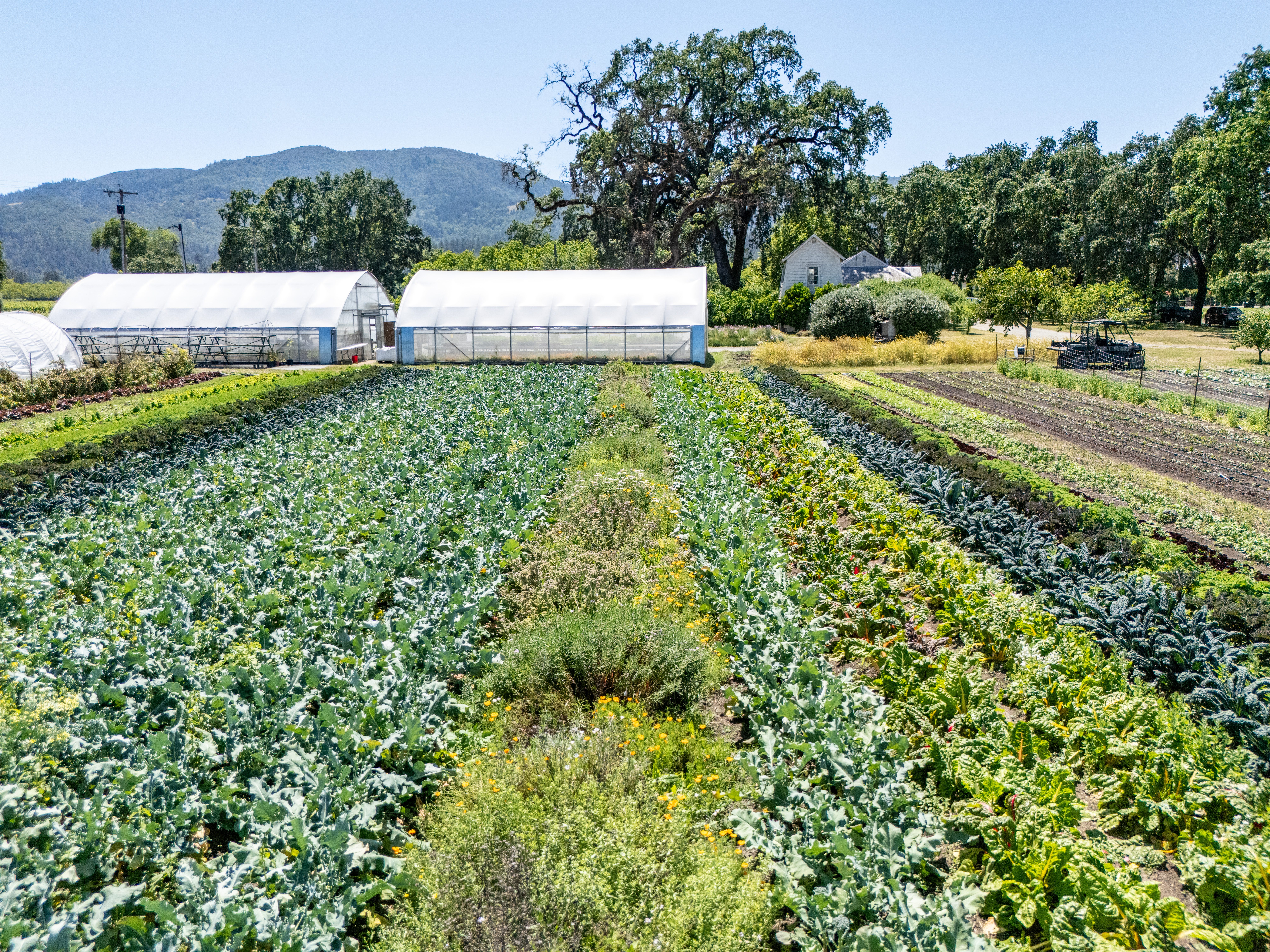
Peter Jacobsen, who has farmed a small parcel within the Yountville city limits with his wife, Gwendolyn, for more than three decades, listened from the edge of the group and nodded through much of Arnsteen’s walk-through. Jacobsen Orchards is roughly an acre and a third, but it supplies about 80% of its produce to Thomas Keller’s three-Michelin-star restaurant, The French Laundry, with the rest going to other Bay Area kitchens. The farm currently grows around 120 varieties of fruit trees and 17 types of citrus, with another Japanese variety on the way. The point is not the variety count itself. It is what an acre and a third of Napa Valley soil can produce when the farming is intentional, diversified and patient. Jacobsen has been making that case for decades. At Long Meadow Ranch he was, in effect, a seasoned voice in a forum exploring diverse approaches to supporting locally grown food.
Penny Proteau, a Napa Valley Master Gardener and a member of the Napa County Beekeepers’ Association, made a related argument from the homeowner side. She said the association leans toward catching swarms rather than buying packaged bees on the theory that a swarm is itself a sign of a colony healthy enough to divide and may carry useful resistance — including to the varroa mite — that a purchased package will not. The group avoids pesticides and herbicides and looks for biological methods where it can.
Her husband, Chip Bouril, a soil conservationist with the federal Natural Resources Conservation Service at the agency’s Napa Service Center, said the growth area in the local work has shifted from grape vineyards to forestry and fire-fuel management on rural hillside properties, including invasive species such as French broom, oblong-leaf spurge and stinkwort that have followed fires through the region. Bouril also pointed to the Napa Communities Firewise Foundation as doing related work locally without routing through the federal government. He returned to native pollinators with a point about aesthetics. A vineyard does not have to be cleanly tilled with no weed in it. A yard does not have to be a manicured flower bed. Once a homeowner understands what the scruffiness is for, it becomes both functional and worth looking at.
Bouril and Proteau have been Land Trust of Napa County members since 1984 and were honored together with the Land Trust’s Acre by Acre Award in 2015 for decades of joint conservation work. At the gathering they represented the long view of what the work actually takes: years of it, in many small institutions at once.
What Napa Valley Used to Grow
The pull of the conversation toward food crops was not new ground. It was older ground.
As Dave Stoneberg laid out in “Prunes and Winegrapes: Looking back at Napa Valley’s Historic Crops” (Feb. 20, 2024) reviewing 101 years of Napa County agricultural reports, the valley spent most of the past century farming a diversified mix of crops. Wheat, harvested as early as the rancho era along the Napa River, made the county one of California’s leading wheat producers in the 1850s. By 1909 more than 500,000 fruit and nut trees grew here, according to the Napa County Historical Society. French prunes were introduced to Napa County in 1883 and became the county’s dominant fruit crop. Apples, cherries, apricots, peaches, pears, plums, tomatoes, olives, almonds, walnuts and dairy were all common at one time or another. Farmers experimented with hops, raisins, tea, mulberry for silkworms and rice in the lowlands.
For 14 consecutive years beginning in 1930, prunes outvalued wine grapes in Napa County. In 1940, animal products — beef, dairy, poultry and eggs — were worth $2.24 million against $560,000 for crushed wine grapes. In 1960, prunes and wine grapes were roughly equal at about $2.2 million each, on 7,651 acres of plum trees for prunes and 9,600 acres of wine grape vineyards. Even as late as 1970, beef production at $7.11 million barely edged wine grapes at $7.10 million as the county’s leading agricultural product, and that was the year then-Agricultural Commissioner Aldo Delfino noted 1,200 acres of prune orchards being removed to make way for vines.
The transition to a near-monoculture of wine grapes was fast. By 2024, the most recent crop year reported, wine grapes accounted for $1.031 billion of Napa County’s $1.035 billion in total agricultural value — about 99.6% of the county’s farm economy, according to the Napa County agricultural commissioner’s office.
The land-use policies that protected farmland in Napa also funneled it toward grapes. On April 9, 1968, the county board of supervisors approved the first agricultural preserve in the United States, locking roughly 23,000 acres into agricultural use. The preserve now covers about 32,000 acres, and no land has ever been removed from it. The California Land Conservation Act, known as the Williamson Act, gave the county a parallel tool for keeping land in agriculture through tax-assessment reductions; Napa entered its first Williamson Act contracts the following year. Together those policies preserved the valley as farmland. What they did not require was diversity.
What was striking about the gathering was that several voices in the room were arguing, without saying it directly, that the recent decades are the anomaly. The longer history of the valley is one of diversified food crops, and the soil and climate that grew them have not changed.
Land That Could Grow Something Else Again
The other thread running through the gathering was land — specifically, what to do with vineyard ground that is coming out as the wine industry contracts.
Evan Wiig, director of membership and communications at the Community Alliance With Family Farmers and the founder of the Farmers Guild network that began in Sonoma County in 2011 and merged with CAFF in 2016, pointed to figures from Sonoma County: about 2,700 acres of vineyards pulled in 2025, with more expected. A November 2025 Land IQ report for the California Association of Winegrape Growers put the figure higher in Napa: 3,100 acres removed between October 2024 and August 2025, alongside an estimated 38,000 acres removed statewide over the same period. Wiig framed the moment as an opportunity and a problem at the same time. Aspiring small-scale farmers cannot compete with vineyard buyers for land, and the average California farmer is now 59.9 years old, according to the 2022 USDA Census of Agriculture.
“How do we get some of that land — maybe not all of it, but at least some of it — into food production?” Wiig said. “Even a small fraction of that. We’re here at Long Meadow Ranch. They’re the largest food producer in the entire county, and if you were to take this farm and put it in Yolo County, it would be the smallest.”
CAFF, along with partners that include the Sonoma and Gold Ridge resource conservation districts and Kitchen Table Advisors, a Berkeley-based nonprofit that helps small-scale farmers with land, financing and business issues, is planning an event in Sonoma County to help landowners considering leasing some of their property to small-scale food-growers think through what a lease looks like for annual crops, how it differs from a perennial crop lease such as a vineyard, and what infrastructure and expectations a beginning farmer would need. Wiig said the session was still being finalized when the gathering took place. He sees the need as greater in Napa than in Sonoma, given Napa’s heavier dependence on grapes, and was openly interested in whether the same model could be brought across the county line.
Rachel Kohn Obut, who has been managing culinary gardens in Napa and Sonoma counties since 2010 and serves as the consulting gardener at the Culinary Institute of America at Copia, has been one of the organizers of the Napa Farmers Guild since restarting it in late 2022 with Jacob Tracy, the culinary gardener at Copia. She runs her own farming and consulting business, Little Moon Farm. She said the guild is loose by design — no website, no dues, an email address — and was uncertain how far the vineyard contraction had moved in Napa. The clearest signal she had seen was that smaller home vineyards were coming out first, not the larger commercial blocks.


A Federal Program Pulled Mid-Contract
Wiig also brought up a piece of context that hangs over any conversation about small-farm economics in California right now. The Farms Together program — California’s deployment of the federal Local Food Purchase Assistance Program, or LFPA — paid small farmers to supply fresh produce to food banks. He described it as a two-sided fix: a market for growers who otherwise could not break into food-bank supply chains and fresh local food for families using those food banks. According to CAFF, by the time the program was terminated, Farms Together had engaged more than 830 California farmers — more than 70% of them small, mid-scale or socially disadvantaged — along with 45 food hubs and aggregators and 50 food banks and community organizations, with nearly $60 million spent.
The U.S. Department of Agriculture terminated the 2025 funding tranche, LFPA25, in March 2025, stating that the program “no longer effectuates agency priorities.” Earlier LFPA and LFPA Plus agreements, which had remaining funds, were allowed to continue through their original end dates after a brief freeze and appeal. Gov. Gavin Newsom appealed the termination in April 2025. CAFF is now urging state legislators to invest $45 million in state resources to keep Farms Together running, an effort being led by Assemblymember Gail Pellerin and state Sen. Melissa Hurtado, who chairs the Senate Agriculture Committee. The governor’s May 14 budget revision, released six days before the gathering, did not propose significant new ongoing General Fund spending. The legislative session would decide whether Farms Together survives.

What This Gathering Was Trying to Say
By the end of the afternoon, the threads of the conversation had braided into something that resembled an argument, although no one delivered it as one.
If the wine industry in Napa Valley continues to contract — and the consensus in the room, qualified but clear, was that it will — the question is not only what comes off the ground. It is what goes back on. A diversified 6-acre farm with a hedgerow can support more than crops. It can support the bees Keller is trying to keep alive, the wild pollinators Erin Arnsteen is trying to bring back one milkweed start at a time, the soil biology that Jess Arnsteen treats as the basic case for not spraying, the kind of intensive small-acreage food production Peter Jacobsen has spent 35 years demonstrating in Yountville, and the next-generation growers that Wiig argues cannot find land at a workable price. Each of those things on its own is partial. Together, on a piece of ground that used to be vineyard or once was something else entirely, they form something closer to a working system. They also look a lot like what the valley used to be before the vineyards covered everything — only with a century of accumulated knowledge layered on top.
That is not a transition plan. It is a sketch of one. The infrastructure for it — land leases, technical assistance, market channels, pollinator habitat at scale — does not currently exist in Napa County at any meaningful size. The Napa Farmers Guild meets without a budget. The federal funding for the food-bank channel has been cut. The leasing workshops are happening in the next county over.
Still, the gathering itself was the point. Several dozen people who care about a future for working land in Napa Valley stood under live oaks on a 6-acre farm surrounded by vines, traded contact information and talked about what they were already doing, would be doing or hoped to do. No one was waiting for permission. The Napa Farmers Guild can be reached at napafarmersguild@gmail.com.
--
Tim Carl is a Napa Valley-based photojournalist.
Today’s Polls:
Poem of the Day:
“The Corn Song”
By John Wesley Holloway
Jes’ beyan a clump o’ pines—
    Lis’n to ’im now!—
Hyah de jolly black boy,
    Singin’, at his plow!
In de early mornin’,
    Thoo de hazy air,
Loud an’ clear, sweet an’ strong
    Comes de music rare:

“O mah dovee, Who-ah!
Do you love me? Who-ah!
            Who-ah!”
An’ as ’e tu’ns de cotton row,
Hyah ’im tell ’is ol’ mule so;
    “Whoa! Har! Come ’ere!”

Don’t yo’ love a co’n song?
    How it stirs yo’ blood!
Ever’body list’nin’,
    In de neighborhood!
Standin’ in yo’ front do’
    In de misty mo’n,
Hyah de jolly black boy,
    Singin’ in de co’n:

“O Miss Julie, Who-ah!
Love me truly, Who-ah!
            Who-ah!”
Hyah ’im scol’ ’is mule so,
W’en ’e try to mek ’im go:
    “Gee! Whoa! Come ’ere!”

O you jolly black boy,
    Yod’lin’ in de co’n,
Callin’ to yo’ dawlin’.
    In de dewy mo’n,
Love ’er, boy, forevah,
    Yodel ever’ day;
Only le’ me lis’n,
    As yo’ sing away:

“O mah dawlin’! Who-ah!
Hyah me callin’! Who-ah!
            Who-ah!”
Tu’n aroun’ anothah row,
Holler to yo’ mule so:
    “Whoa! Har! Come ’ere!”
About the author: John Wesley Holloway was an American poet born in Meriwether County, Georgia, in 1865. He studied at Clark University in Atlanta and Fisk University in Nashville and was associated for a time with the Fisk Jubilee Singers. His poems appeared in James Weldon Johnson’s 1922 anthology “The Book of American Negro Poetry,” an important early collection documenting African American literary voices in the late 19th and early 20th centuries.
Holloway’s work is marked by musical phrasing, rural settings and the use of dialect shaped by oral performance traditions and Southern Black vernacular speech. “The Corn Song” reflects the cadence of work songs and call-and-response singing, blending agricultural labor, courtship and communal sound into a lyrical portrait of field life. His poetry is often discussed alongside writers such as Paul Laurence Dunbar, whose work also explored musicality and spoken vernacular traditions.
Are you a poet, or do you have a favorite piece of verse you’d like to share? Napa Valley Features invites you to submit your poems for consideration in this series. Email your submissions to napavalleyfeatures@gmail.com with the subject line: “Poem of the Day Submission.” Selected poets will receive a one-year paid subscription to Napa Valley Features (a $60 value). We can’t wait to hear from you.
Today’s Caption Contest:
Pick your favorite caption or add your own in the comments below.

Possible Captions:
“Formerly Just Another Cow”
“Modern Cow (Late Agricultural Period)”
“Artisanal Grazing Unit”
“Grass-Fed, Atmosphere-Aware”
“Please Do Not Discuss Retail Value Near Exhibit”
Last Week’s Contest Results:
In “Heidi Peterson Barrett Brings La Sirena Into the Light,” the winning caption was “The males grow increasingly decorative with age,” with 50% of the votes.

Caption Options:
“Very little is known about their private lives.”
“They tend to gather after sunset.”
“The males grow increasingly decorative with age.”
“In colder months they become deeply domestic.”
“By evening they settle into familiar positions.”
Explore These Related Articles:


Browse All Napa Valley Features Stories
Browse All Sonoma County Features Stories
Browse All Lake County Features Stories
—
The views, opinions and data presented in this article are those of the author and do not necessarily reflect the official policy, position or perspective of Napa Valley Features or its editorial team. Any content provided by our authors is their own and is not intended to malign any group, organization, company or individual.
A most important article-thanks for planting the seeds for ag diversification. Might we all plant some California natives t help the bees along.
Bravo. Terrific and fascinating article. Not to mention inspiring. thanks!