


Summary: Dan Berger contrasts the informal, wine-first tasting rooms of Napa Valley’s past with an increasingly expensive hospitality model built around reservations, elaborate experiences and luxury trappings. He argues that rising fees and tightly controlled tastings can alienate serious wine-buyers as well as casual visitors who simply want to taste before purchasing. Recalling modest visits in Napa and France, Berger makes the case for wine as an accessible part of conversation and daily life rather than a marker of class. The result, he writes, is a widening divide between wine culture’s communal roots and the exclusivity projected by some modern estates.
“Unfortunately, as it is now being highlighted in many of our redesigned, gold-flecked edifices, it seems to be doing quite the opposite — illustrating a gulf between us-versus-them classes, and it may be doing more to divide us than to unite us.” — Dan Berger
NAPA VALLEY, Calif. — A distant cousin and her husband are coming to visit in a few weeks. He is a world traveler who spent decades overseas on business. They live in New York City and are sophisticated people.
On a visit to their home 20-plus years ago, I learned that both were fascinated with fine wine but didn’t really appreciate ostentation or wines that displayed pretension. They knew a good bottle when they tasted it, and they didn’t think much of spending ludicrous amounts on a wine “experience.” Many a $15 or $30 bottle displayed the character that they appreciated.
So when they visit in a few weeks, I will not be taking them to the Napa Valley, a place that today is a turnoff to people looking for fine wine that’s affordable. Far too many people in this country have the impression that “California Wine Country” is properly depicted in a Disney movie, complete with late-model sports cars, rare sparkling wines that the producers always incorrectly identify as Champagne and places where the winemaker (always a man) wears Armani suits during harvest.
By creating this absurd silver-screen image, which was recently depicted on the pages of The New York Times, people everywhere get the distinct impression that lobster for lunch is a routine Wine Country activity and thus is beyond the reach of anyone who can’t afford it. Which is almost everyone.
Things were not always thus.
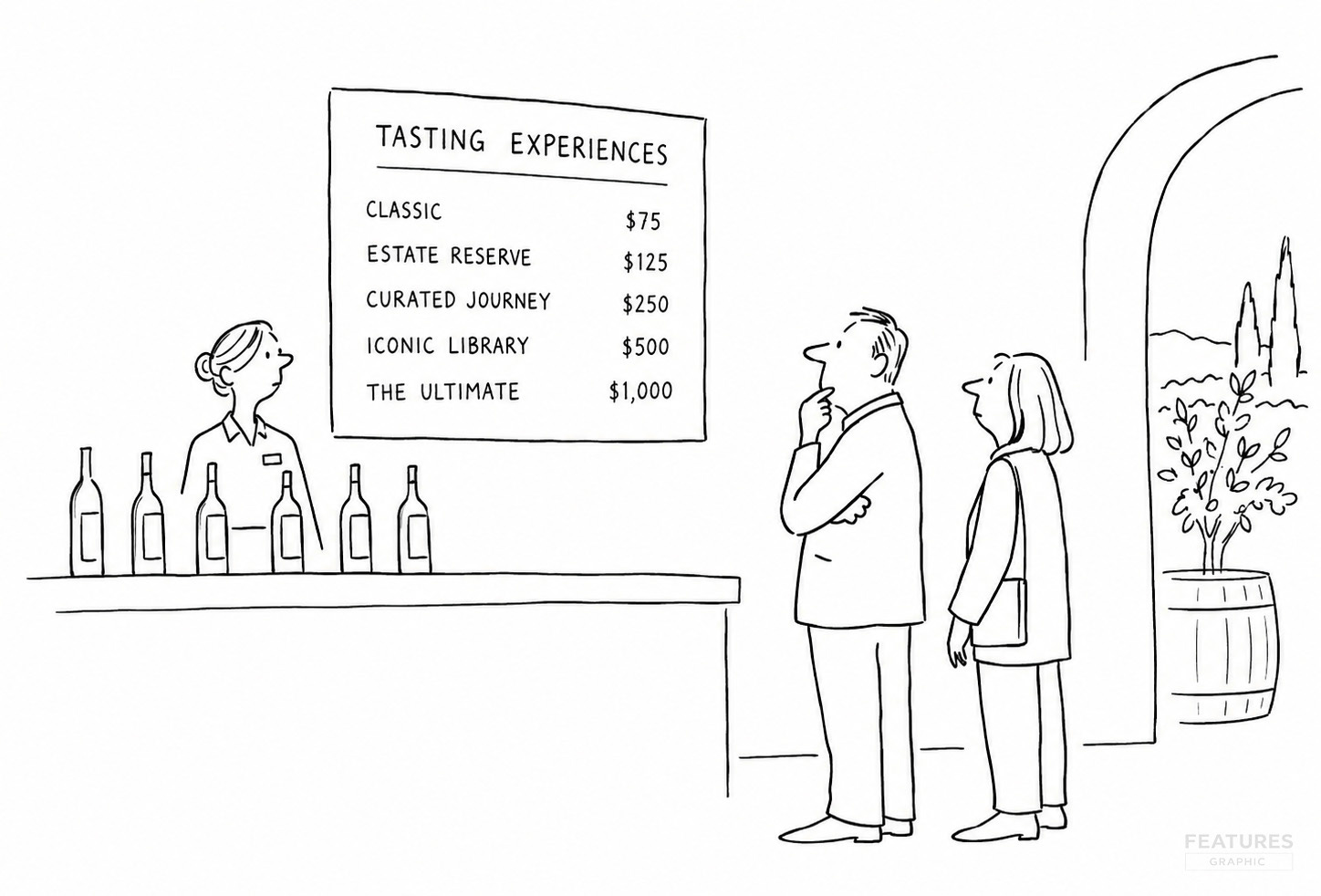
My first visit to the Napa Valley in 1976 was when wine and life were simpler. I need not go into detail on how outrageous things have gotten in Wine Country, mainly because most of our readers know exactly what visitors now face — excessively high costs for tasting, reservations required to taste and being allowed to taste only the wines that the tasting room is serving that day.
And it’s even worse than that. A good friend who joined me on my first Napa visit in 1976 to see several wineries was reminiscing the other day and compared the old days to his recent experiences in tasting rooms. He was not impressed. The display of pretension he encountered left him believing that some newcomers experiencing today’s Napa Valley for the first time might decide it is also the last time.
He is a former executive in the wine industry who now lives in Napa. He left the industry a few years ago.
“I’m happier every day that I’m retired from this sort of thing,” he said. “There’s a very simple answer to the issues facing wineries now, at least in Napa and Sonoma: too many wineries offering too much. There are some 500 wineries in the Napa Valley plus another 1,000 brands associated with Napa. No wonder the consumer shrugs and walks away, especially with tastings costing $75 — or $1,000 per person for a ‘curated’ tasting and tour with food and wine pairings. I don’t visit wineries much. It’s all just too much.”
He added, “[I] walk in, and when they ask if I have a reservation and I say I just wanted to buy some wine, they’re always mildly surprised. (There are) no simple tastings pretty much anywhere anymore. (They’re mostly) seated and with pre-selected wines. Mostly I have no interest in them. It stops them cold when you ask to taste one or two wines only to make a purchase decision. And now I read that after paying $150 for two persons to taste, the tasting room ‘host’ anticipates a tip!”
On our first visit to Napa in 1976, we visited Caymus. No reflecting pool. No chandeliers, no crystal stemware. Parking was rustic. We wanted to try the 1973 cabernet. No problem. No charge. We each bought a bottle. The guy in the tasting room seemed pleased that we liked it enough to buy it. He did not seem to be disappointed that we didn’t buy more.
We also visited another Napa Valley property that day. It has since gone out of business. There was no tasting room. We wandered into the dusty winery through a side door and were greeted by a winery worker. He probably knew less about wine than we did. We asked to try the cabernet. He opened a bottle. It was passable. I bought one. My friend did not. The entire episode lasted less than 10 minutes.
I have been a dedicated wine-lover for almost 60 years. For the first two decades I visited wineries to try specific wines in which I had an interest. If a wine measured up, I’d plunk my money down. These episodes rarely included a faux history lesson or someone trying to impress me with how much they spent on an oak barrel.
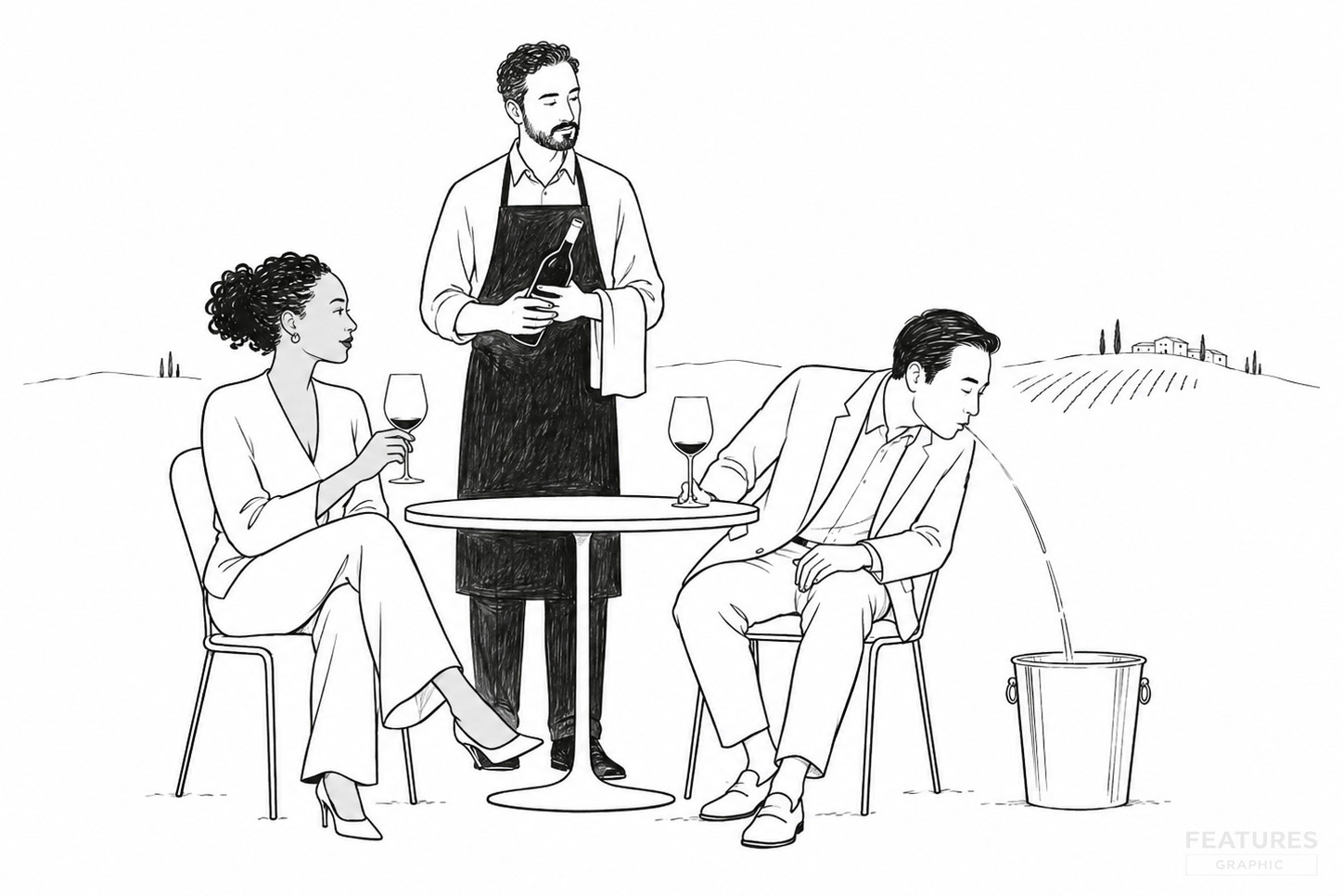
In recent years, I have heard from others like me who are similarly situated. They are people who like wine and usually have a target when they visit a winery. They are not interested in trying every wine the tasting room host is pouring that day. Nor do they have any interest in a lobster lunch, a hayride, a tractor tour of a vineyard, a cave walk, 3 ounces of a poorly stored, too-old red wine, faux cobwebs or soothing cool-jazz tones from a surreptitiously placed Sonos.
Given the arduousness of arranging tastings, the costs involved and the logistics, it amazes me that winery owners cry foul when one of those stretches comes along when wine sales hit a brick wall. Have wineries done anything to encourage tasters to try their wines as they once did in the 1960s or 1970s? If anything, imposing hefty fees has discouraged potential purchasers of their wines from ever stepping foot inside their marble palaces.
I always looked at winery tasting rooms as if they were automobile showrooms. Before buying, the dealer encourages you to take a drive. It’s the least he or she could do to accommodate potential buyers’ curiosity. Were the seats comfortable? How was the acceleration and braking?
About 30 years ago my wife and I visited the Loire Valley. The only reservation we needed was for a hotel room in Chinon. All of our other stops were impromptu. Almost every property was modest.
At one cottage with a tiny winery 50 yards farther back, a sign indicated that we could enter. We walked into a vestibule; it was really nothing more than an entryway. There was no counter. A couched man in his 70s was in a back room watching TV — soccer or something that was entertaining a raucous crowd.
He sauntered over. His English was broken and my French was fractured, but we got the message across that we would like to try his wines. He had a white wine and two reds. His son was the winemaker, he said; he grew grapes. The wines were terrific. We bought all three bottles. The prices were absurdly low. There was no tax. The rumpled paper bag he used so we could carry them back to the car had come from a farmers market, I suspect.
In the last few years several iconic Napa Valley wineries have spent outrageous sums to redesign and upgrade the appearance of their winery properties and not only the wineries themselves. The improvement in their physical appearances included facilities for elegant hospitality events.
Such facilities clearly are intended to lavishly accommodate the anticipated hordes of well-heeled supplicants who believe that lobster and cabernet really do go perfectly well together and who have the financial wherewithal to feast in homage to the forebears who never experienced a similar repast.
At this particular moment in this country’s 250-year history, when ordinary people cannot get ordinary, unspoiled food at a fair price or care to keep their family healthy, when school systems are allowed to collapse, when libraries and museums are under attack, when the edges of society are allowed to crumble to honor mammon, wine should be the beverage of conversation, of dinner table engagement, and a way to bind family units the way this beverage has always been historically used in civil and religious ceremony.
Unfortunately as it is now being highlighted in many of our redesigned, gold-flecked edifices, it seems to be doing quite the opposite — illustrating a gulf between us-versus-them classes, and it may be doing more to divide us than to unite us.
—
Dan Berger has been writing about wine since 1975.
Wine Discovery:
2024 Arsenal Malbec, Napa Valley ($57.60, 305 cases) — Sourced from Stagecoach Vineyard, Haymaker Vineyard on Howell Mountain and Cavey Estate Vineyard on Diamond Mountain, this 100% malbec reflects Venge Vineyards’ focus on mountain-grown fruit from across Napa Valley. Aromas of blackberry, ripe plum and violet lead into notes of dried black cherry, olive, dark chocolate, espresso and toasted oak. The palate is broad and plush, with blackberry and black cherry framed by velvety tannins and a firm, polished structure through the finish. Titratable acidity is about 0.60% and alcohol is approximately 15.5%, giving the wine weight while retaining enough freshness to keep the fruit in balance. Pair with braised short ribs, grilled lamb chops or wild mushroom polenta.
Winemaker Kirk Venge is a second-generation Napa Valley vintner, the son of noted winemaker Nils Venge, and he grew up among the vineyards, cellars and tasting rooms that shaped his family’s career. Today he continues that winemaking tradition through Venge Vineyards in Napa while also owning Croix Estate in Sonoma County, where his work extends to pinot noir, chardonnay, sauvignon blanc, zinfandel and other varieties. — Tim Carl Review.
Today’s Polls:
Explore These Related Articles:


Browse All Napa Valley Features Stories
The views, opinions and data presented in this article are those of the author and do not necessarily reflect the official policy, position or perspective of Napa Valley Features or its editorial team. Any content provided by our authors is their own and is not intended to malign any group, organization, company or individual.
Our illustrations are produced through a multistep process of generative tools, digital sketching and photo editing, often starting from our own images or sketches.
Dan Berger is spot on about Napa Valley, where I live. I am retired from the wine business and am grateful for the experience. When friends and family visit us, we may visit a winery or two for its artwork and if the staff discover I was in the industry we will get comped, which is nice. Otherwise, we entertain at home or at a restaurant, and the wines are typically Old World.
Jeff:
Thanks for sharing your experience with our readers. One thing that I didn't include in the article was the fact that some of the tastings that we pay so exorbitantly for include wines that sell for $150. Some people find this to be exciting. But when the other wines that they are serving have a suggested retail price of $25 or $35 per bottle and require a tasting fee of $60 for a 2-ounce pour, the value is so poor as to be absurd. It discourages locals from supporting nearby wineries.