


Correction and Clarification:
Ted Hall clarified that he has been in Napa Valley since 1989, has made wine since 1971 and joined the Mondavi board because of his wine experience and McKinsey background.
He also clarified that the 424 figure refers to Napa Valley Vintners members producing fewer than 10,000 cases annually.
The Spotlight:
Between April 5 and April 20, multiple public events described a Napa wine industry that has shifted its marketing audience from consumers to regulators, courts and investors. Today’s edition is devoted to that story in full — “Under the Hood: Where Is Napa in the Five Stages of Grief?” — with regular features returning next Thursday. The interactive calculator on NapaServe allows readers to substitute their own assumptions for tier contractions and pass-through rates and see the math update live. The paywall is off this week. There is a full list of sources at the end of the article.
Summary:
Between April 5 and April 20, 2026, Napa Valley’s producer base revealed its tier-stratified response to a decade-long contraction in U.S. wine demand. Two of the four largest producers — Constellation Brands and Treasury Wine Estates — have written down their U.S. assets and withdrawn forward guidance, Treasury in October and Constellation in April. Two others — Gallo and Trinchero — are selectively divesting: Gallo closing its super-premium Ranch Winery in St. Helena, Trinchero listing its Haystack and Cloud’s Nest vineyards for sale. Among smaller producers, Ted Hall — former chairman of Robert Mondavi Corp. — estimates 100 to 170 of 424 Napa Valley Vintners members producing fewer than 10,000 cases are “unlikely to be economically viable under current conditions.” Three Napa wineries won a Ninth Circuit revival of their First Amendment suit against the county. And the four principal trade groups jointly petitioned the county for 23 regulatory changes to the framework they themselves helped build. Read together, the events describe actors at different stages of response to a market that has itself shrunk — for demographic, health, income and competitive reasons no rule change can reverse. An interactive calculator lets readers test assumptions about how winery contraction across tiers flows through to the 55,875 jobs, $3.82 billion in wages and $507 million in tax revenue the wine-related economy anchors.
Under the Hood: Where Is Napa in the Five Stages of Grief?
By Tim Carl
NAPA VALLEY, Calif. — Between April 5 and April 20, a series of public actions from across the Napa wine industry arrived from actors with little apparent coordination: A former chairman of the Robert Mondavi Corp. published an economic diagnosis; Treasury Wine Estates, the Australian-listed global wine company, confirmed a $700 million impairment against its U.S. assets; Constellation Brands reported a collapsing wine segment; three small Napa wineries won a federal appellate revival of their suit against the county; four trade groups filed a joint regulatory petition; and Constellation reopened its Robert Mondavi flagship in Oakville after a renovation at the top of the market.
Read together, the actions describe an industry in which different tiers of the producer base are at different stages of response to the same underlying condition. The framework is familiar — the five stages psychiatrist Elisabeth Kübler-Ross first described for individuals confronting terminal diagnosis, later adapted for industries and institutions absorbing structural change: denial, anger, bargaining, depression, acceptance. Denial is the stage one does not announce; its evidence is continuation unchanged. Anger looks for a cause outside the self and often arrives in litigation. Bargaining offers modified terms in exchange for preserving the current posture. Depression is the quiet winding-down visible only to those inside it. Acceptance is the stage at which structure actually changes. The tiers of Napa’s producer base are distributed across all five simultaneously, and they are not moving together.
Large producers have moved through denial and bargaining and arrived at a kind of acceptance: They are writing down their U.S. positions, divesting what cannot clear and concentrating on what can. Midsize producers are still in bargaining. Small producers are dispersed — some continuing unchanged, some suing in anger, some absorbing Ted Hall’s April 5 diagnosis that 100 to 170 of their cohort are operating beyond the point of long-term viability. The four trade groups representing the valley’s producer base are at system-level bargaining: asking the county to rewrite the rules that built Napa so the current operator count can continue.
What makes the two-week window analytically useful is that no institutional actor in it names the condition the large producers have already implicitly accepted: that U.S. wine consumption has been contracting for reasons demographic, health-related, income-related and competitive, that the contraction is structural rather than cyclical, and that no regulatory change restores a market that has itself shrunk. This publication has documented that condition for more than a decade. Its naming inside the valley’s senior institutions remains incomplete.

Capital: Constellation’s Verdict
Constellation Brands released its fiscal fourth-quarter results on April 8. The company reports its Wine & Spirits segment separately from its much larger Beer business — Modelo, Corona, Pacifico — which has driven most of Constellation’s growth for the past decade. The Wine segment includes wineries across Napa, Sonoma, Washington and several international portfolios.
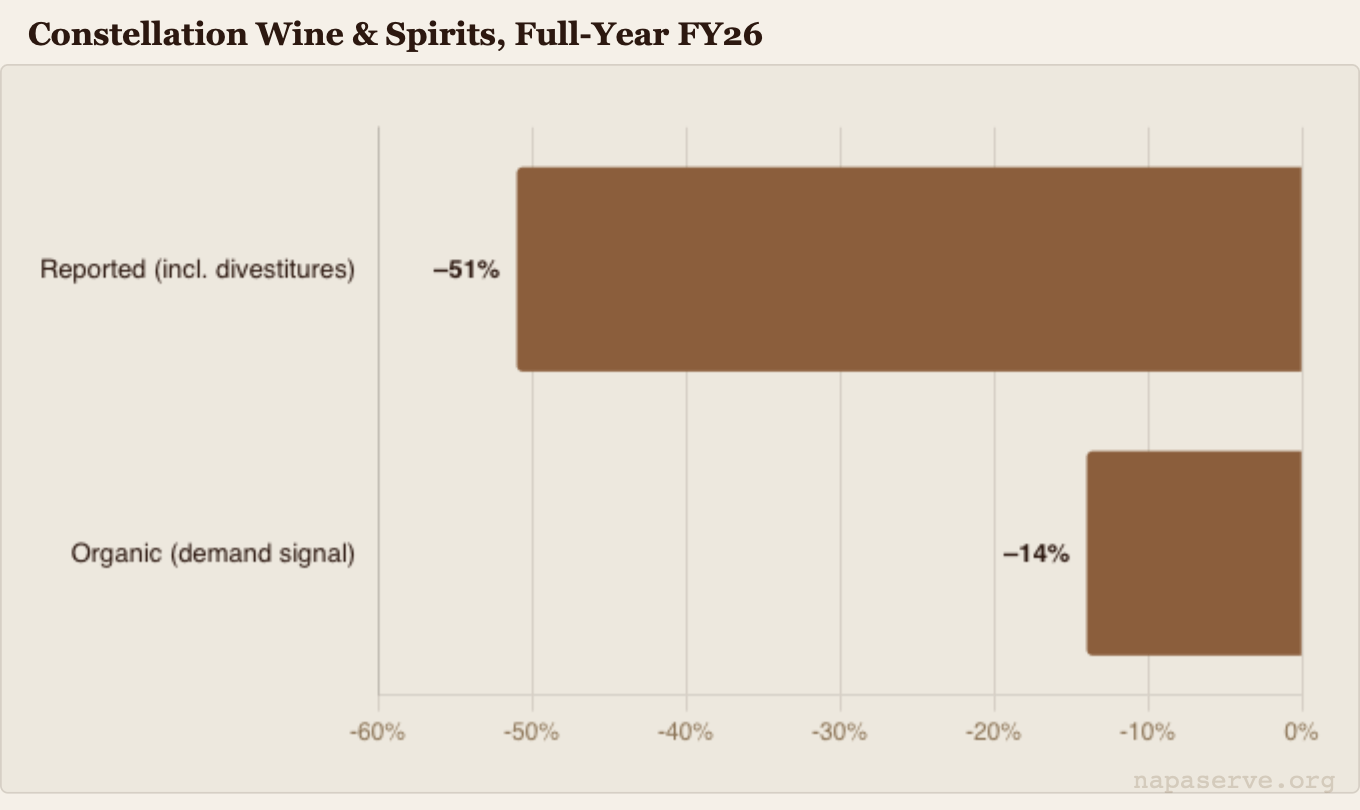
For the full fiscal year, Wine & Spirits net sales fell 51% to $823.8 million. In the fourth quarter alone, net sales fell 58% to $194 million. The reported figures include the 2025 divestitures of Mondavi Private Selection, Ruffino, Cook’s and J. Roget, which were sold to The Wine Group. Those brands represented most of the company’s mid-tier volume, and their removal accounts for the steepness of the headline decline.
The organic numbers — the underlying demand signal — are more diagnostic. On an organic basis, stripping out the divested brands, wine and spirits net sales fell 14% for the year and 6% in the fourth quarter. Organic depletions, the measure of what distributors actually sold through to retailers and restaurants, fell 4.3%. The widening gap across these layers is the diagnostic part. Depletions are what consumers actually bought. Shipments are what Constellation sent to distributors.
Net sales are what distributors paid. Constellation shipped less than distributors sold through; distributors sold through less than consumers bought. Inventory is backing up at every point in the chain.

One measure of how far Constellation has pulled back: It fell from the third-largest U.S. wine company in 2024 to the 28th-largest in 2026, according to Wine Business Monthly. Its wine-and-spirits segment made up just 9% of the fourth quarter’s overall sales. The remaining ~91% is beer. That is the structural reality behind the restructured language in Nicholas Fink’s announcement — Constellation is now primarily a beer company that owns a handful of premium wine estates.
On the earnings call, chief financial officer Garth Hankinson cited tasting-room softness at the company’s Napa-based wineries as a specific drag on the quarter. Five days later, on April 13, the company announced that chief executive Bill Newlands would be succeeded by Fink. In the announcement, Fink described the Wine & Spirits business as having been restructured — a word that acknowledges the divestitures but also signals that the remaining portfolio is the one the new leadership intends to stand behind. Constellation withdrew its fiscal 2028 forward guidance entirely, citing limited near-term visibility.
The market read the release as confirmation of the company’s beer-forward strategy. Shares of Constellation rose from $150 to $165 on the news. Investors were not rewarding the wine portfolio. They were rewarding the discipline of shrinking it.
Diagnosis: Denial Ends When the Insider Says It
On April 5, three days before Constellation reported, Ted Hall published an essay titled “Napa’s Luxury Squeeze” on his Substack platform. Hall entered Napa in 2004 as chairman of the Robert Mondavi Corp. during the year that ended with its sale to Constellation. He is a former senior partner at McKinsey & Co. and a founder of the McKinsey Global Institute, and he now owns Long Meadow Ranch.
Hall’s central estimate is that 100 to 170 Napa wineries — roughly 25% to 40% of a specific segment — are under significant economic pressure and unlikely to meet a standard of long-term viability without material change. He is careful about the framing. The estimate is not a forecast of failures, he writes; it is a description of current conditions. The relevant population he identifies is made up of the 424 Napa Valley Vintners members producing fewer than 10,000 cases a year. Within that segment, Silicon Valley Bank’s wine-industry data show the share of profitable wineries fell from roughly 76% in 2021 to approximately 50% in 2024. Applied to the small-winery cohort, that implies roughly 200 wineries operating at or near break-even. Applied against a more demanding standard of long-term viability — debt service, facility maintenance, customer acquisition, reasonable return on capital — the at-risk cohort narrows to the 100-to-170 range.
Hall’s comparison is with Bordeaux, which has 81 Classified Growths across red and white wines and a broader cru bourgeois category of roughly 250 estates, many priced below Napa’s core luxury tier. Napa, he writes, has created several hundred wines aspiring to similar ultra-premium positioning at equal or higher prices from a valley one-sixth the size of Bordeaux. He calls the result unprecedented dilution rather than congestion — a region that overshot not in price but in positioning. To work through the resulting overcapacity at a reasonable pace, Hall arrives at roughly 35 to 40 exits, reversions, mergers or major restructurings each year for the next three years. Not a natural rate of attrition — a serious structural reset.
None of Hall’s underlying data is new. This publication and its contributors have been documenting the same structural condition for more than a decade — through the Vine Wise column in NorthBay Biz, through years of coverage in the Napa Valley Register, through reporting for The Washington Post and, for the past three years, through Napa Valley Features. In October 2023 we described the valley as caught between a rock and a hard place. In January 2024 we asked whether the wine boom was over. In January 2026, two years of accumulated data let us answer the question plainly: Yes, the boom is over. A companion piece the same month — “Napa County’s Wine Market Is Clearing, Not Recovering” — framed what was happening not as a downturn but as a market clearing. The structural diagnosis has never been the scarce resource. Willingness inside the industry to name it has been.
That is what April 5 changed. Hall is not an outside critic. He is a former chairman of Mondavi and a senior figure in the valley’s own agricultural establishment. When the diagnosis is published under that name, the industry’s long internal posture — that the pressure was cyclical, that the valley’s halo would absorb it, that aggressive marketing could restore the conditions of the previous decade — becomes harder to sustain. Hall did not break news. He ended a stance.

The stages of what comes next are already visible across the other four signals this month. The framework is a familiar one. Denial is the stance that is ending. What follows it, before acceptance, are anger, bargaining and depression. The trade-group petition filed on April 14 is a textbook bargaining move: a request that the rules be rewritten so that the current operating model, which the market is rejecting, can continue. The Ninth Circuit suit revived on April 13 carries an edge of anger — three producers arguing that the framework itself is the cause of harm. Depression, the quiet, unglamorous stage of closures, reversions and exits that no one announces, is already underway for some operators, and Hall’s estimate is, in effect, a measurement of how far into it the valley already is. Acceptance, which is the stage at which the structure actually changes, is not yet present in the public record.
Read against the Constellation release three days later, the pairing is diagnostic. Hall described the condition. Constellation disclosed its exposure. Both describe the same underlying market. The difference is that Constellation has already moved to acceptance: It divested the brands that would not clear, invested behind the ones that would and restructured around both. That is what the valley has not yet done.
Policy and the Courts: Two Stages, Arriving Together
On April 13, the same day Constellation announced its leadership transition, the Ninth Circuit Court of Appeals reversed a district-court dismissal and revived constitutional claims brought by three Napa producers — Hoopes Vineyard, Smith-Madrone Vineyard and Summit Lake Vineyards — against Napa County. A panel of the appeals court ruled that the producers’ retaliation and First Amendment claims deserved adjudication rather than dismissal and sent the case back to federal district court. The producers argue that current regulatory restrictions — rules shaped over the past two decades with the industry’s own participation — now prevent viable operation under present market conditions. The revival moves the case toward a substantive record, which, if the litigation proceeds, will begin to document in public filings the specific economics that the trade groups themselves are describing in policy language.
That trade-group petition arrived the next day. On April 14, four of the valley’s principal industry organizations — the Napa Valley Vintners, the Napa Valley Grapegrowers, Winegrowers of Napa County and the Napa County Farm Bureau — filed a joint petition with the Napa County Board of Supervisors requesting 23 reforms to the regulatory framework governing winery operations. The requests include substantial changes to the Winery Definition Ordinance, revisions to visitation caps, adjustments to event-hosting rules and expanded direct-to-consumer sales permissions.
What is unusual is not the content of the petition — most of its individual elements have been debated for years — but the signatories. The four groups represent nearly every organized producer interest in the valley. They have rarely acted in concert on substantive regulatory reform. Their joint filing is not an expansion request. It is, in the language of Hall’s diagnosis, a collective acknowledgment that the rules as currently written assume a market that no longer exists.
The Ninth Circuit revival and the four-group petition point at the same underlying condition from opposite directions. The producers’ suit argues that the rules prevent viable operation. The trade-group petition asks the county to rewrite the rules so operation becomes viable. Both concede what the earnings call, the essay and the reopening confirm: The current framework does not fit the current market. Both also stop short of the recognition Hall names directly — that the number of operators the framework is meant to protect may itself be larger than the market can support. On the hospitality side, our July 2025 analysis of tasting-room arithmetic and the August 2025 analysis of rooms versus jobs have already shown why volume strategies no longer reach their historical payoff. The current petition does not address that arithmetic.
The Board of Supervisors is expected to respond by the June hearing cycle. That response will signal the direction the county intends to take — holding up the ag preserve or the market forces as the framework for the future.
What Contraction Looks Like Across the Wine Economy
In March of this year, Napa Valley Features examined what percentage changes to Napa’s wine-related economy would mean for the county’s jobs, wages and tax revenue. The framework applied proportional scaling to the 2022 Insel & Company economic impact study commissioned by Napa Valley Vintners, which found the wine-related economy — wineries, growers, tourism, hospitality workers, suppliers, warehousing and transport combined — accounts for 72% of Napa County employment and 73.7% of wages paid in the county. The question at the time was largely theoretical. The evidence that has accumulated since has made it less so.
Napa’s wineries are not one thing. They are three. Small wineries producing fewer than 10,000 cases a year — the cohort Hall describes, 424 Napa Valley Vintners members (the NVV often refers to its membership as closer to 550) — tend toward ceasing operation: sold, reverted to grower-only, closed. Midsize wineries between 10,000 and 100,000 cases rarely vanish; they cut production. One such Napa winery reported in January of this year that it is planning to reduce production by 80%, from roughly 50,000 cases to 10,000, in a five-year workout with its bank. Large producers — Constellation, Gallo, Trinchero, Treasury — restructure. Constellation’s wine segment dropped from the nation’s third-largest wine producer to the 28th as it divested Mondavi Private Selection, Ruffino, Cook’s and J. Roget. No tier is growing production.
Hall’s estimate is scoped to the small-winery tier. It does not include the county’s largest producers, which are not often NVV members, and it does not include the midsize tier where this publication’s reporting has documented the sharpest pressure. Our 2024 grape bifurcation analysis showed mid-tier fruit volumes down 27% with chi-square significance. In March that pattern extended into 2025, with the high-end insulation visible the prior year beginning to erode. Hall’s 100-to-170 figure describes one tier of the winery base. It is useful precisely because it is specific. It is not the ceiling of what the data show.
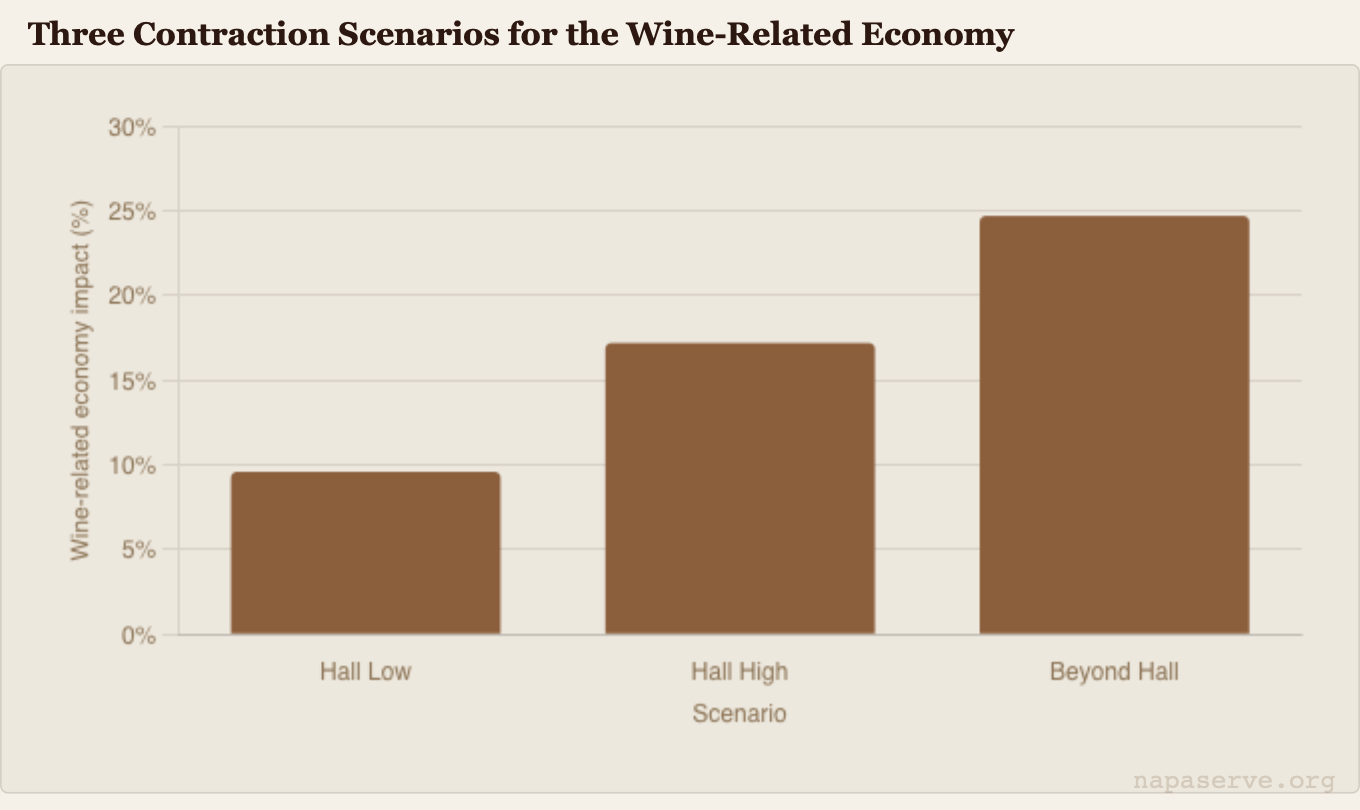
The chart below presents three scenarios applied to Napa’s wine-related economy baseline — the 55,875 jobs, $3.82 billion in wages and $507 million in county and local tax revenue identified by the Insel study. The scenarios work in two layers. Layer one measures how much wineries contract by tier. Layer two measures how much of that winery contraction flows through to the broader wine-related economy: growers, tourism, hospitality workers, suppliers, transport and the induced spending of all of them. A contraction concentrated in small wineries alone likely flows through modestly. A contraction that reaches midsize and large producers — or that pulls down visitor numbers — flows through more. The chart below assumes a 70% pass-through rate. The calculator that follows lets the reader adjust both the tier contractions and the pass-through rate to test their own assumptions. Illustrative only — not a forecast.
A Note About Our Model
Every number in the chart above rests on estimates — how Napa’s $4.4 billion in winery revenue distributes across tiers, how severely each tier contracts under pressure, how winery contraction flows through to growers, tourism workers, suppliers and the rest of the wine-related economy. Reasonable analysts will land on different numbers for every one of those variables. The defaults shown here are NVF’s best synthesis of the published evidence — the Insel & Company 2022 study for the baseline, Ted Hall’s April 2026 essay for the small-winery range, Treasury Wine Estates’ and Constellation Brands’ disclosed write-downs for the large tier, this publication’s grape bifurcation analysis for the midsize tier. But defensible is not the same as correct. Nor is the calculator’s purpose predictive. Its purpose is to show how the documented evidence — which this publication has been accumulating for more than a decade — already exceeds what the public statements this month acknowledge. Rather than defend a single scenario, the online calculator lets you substitute your own assumptions and see what they imply. The chart updates live. If your version of the numbers produces a different answer, that is the point.
Test Your Own Assumptions
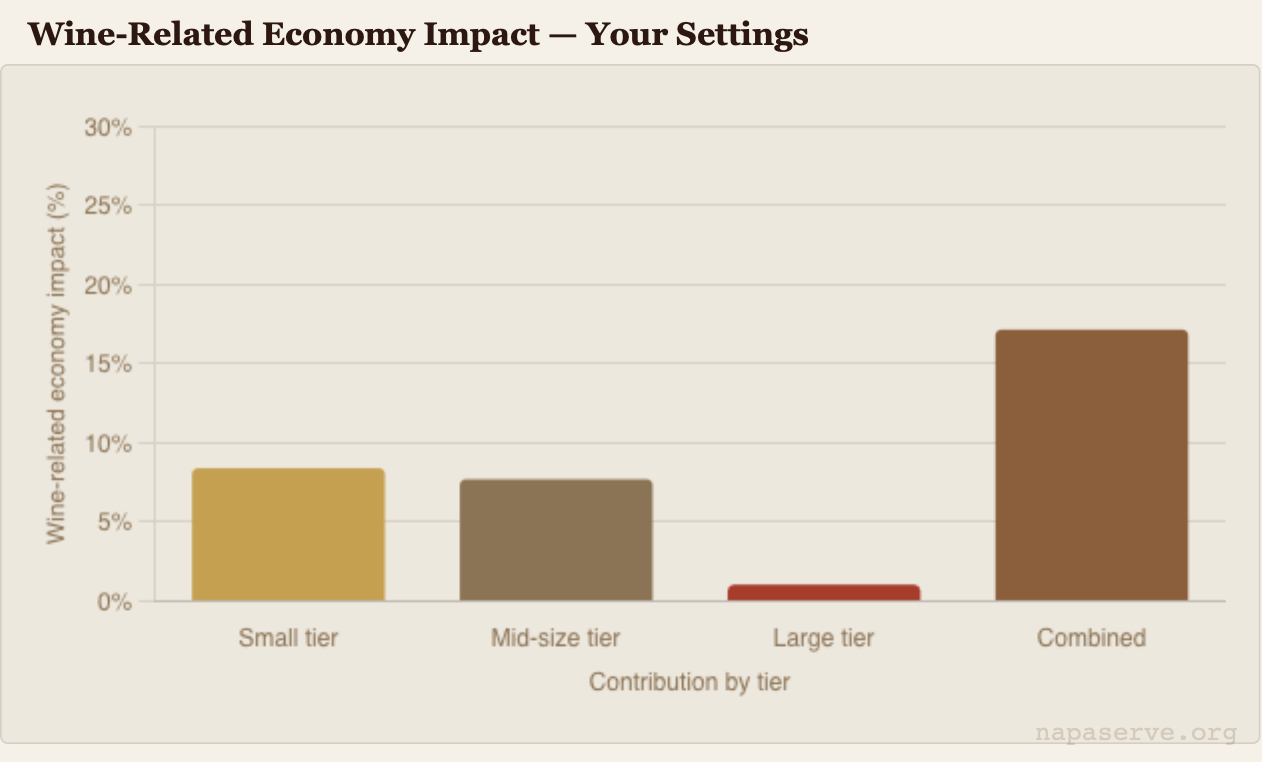
Adjust the tier revenue weights and contraction rates on our online calculator. The output at bottom updates live. Use the scenario presets to match the chart above. We include potential scenarios to run as well as folding in additional aspects of the wine contraction to predict the impact on Napa County.

Calculator Methodology
Illustrative only — not a forecast. Baseline figures are from the Insel & Company 2022 economic impact study for Napa Valley Vintners: 55,875 jobs, $3.82 billion in wages, $507 million in county and local tax revenue and $156 million in property tax. Tier revenue weights (30/55/15 for Small/Mid/Large) are NVF’s illustrative estimates of how Napa’s $4.4 billion in 2022 winery revenue breaks down by producer size. No authoritative published source confirms these weights, so they are adjustable inputs. The pass-through rate represents how winery contraction flows through to the broader wine-related economy (growers, tourism, hospitality, suppliers, transport, induced spending). Impact figures scale linearly with (winery contraction × pass-through rate). Property tax effects are subject to Proposition 13 constraints on reassessment; actual tax impact depends on which parcels change hands and how quickly.
The Barbell: Mondavi and What Capital Is Saying
On April 20, after a three-year closure, Constellation reopened the Robert Mondavi Winery in Oakville. As Jess Lander reported for the San Francisco Chronicle, the renovation was the most ambitious in recent Napa Valley history — a reconstruction whose cost Constellation has not publicly disclosed but that observers place in the hundreds of millions. Mondavi, which hosted more than 350,000 visitors a year before the closure, had drifted over two decades into what Lander describes as a gateway or “Disneyland” winery for first-time visitors. The reopening repositions it toward the high end: Entry tastings rise to $60 from $45 before closure, a Mondavi Table experience runs $95 and a full tour and tasting runs $150.
Constellation did not divest Mondavi as it divested Private Selection, Ruffino, Cook’s and J. Roget. It invested at scale. The statement embedded in that decision is that Constellation believes Napa’s future is barbell-shaped. The pattern is five years in the making: a 2021 sale of 30 lower-priced brands to Gallo for $810 million, followed by the 2025 sale of the remaining entry-level portfolio to The Wine Group, followed by a January 2026 closure of the Madera production facility. The capital that came out of those moves is being redirected to a trophy asset and a narrow band of premium labels above it. Everything in the middle — the crowded luxury lane Hall describes — gets neither.
That is the strategic message: Volume wine is going somewhere else. Beer, which is growing, absorbs most of Constellation’s capital. The top of Napa’s pyramid, which has historically been more defensive during category downturns, absorbs the rest. In that middle lane, owners are being asked to compete against the reopened Mondavi above them, against flexible formats below them and against peers speaking the same language at the same price point all around.
Read beside Hall’s diagnosis, the Mondavi reopening is not a contradiction. It is the complement. Hall describes what the middle is unlikely to sustain. Mondavi, reopened with a $100 million range investment, describes where the largest corporate owner of Napa brands believes the defensible position is. The five events across two weeks do not add up to a crisis narrative. They add up to something harder for the valley to absorb: a public, multi-sourced agreement — across an essay, an earnings call, a federal court docket, a regulatory petition and a hospitality reinvestment — that the structure has to change and that the change is large.
None of that agreement is yet acceptance at the scale that would produce structural change. The Board of Supervisors has not responded to the petition. The trade groups’ petition asks for the rules to change so the current operator count can continue. The 100-to-170 figure — the proposition that the current operator count itself — exceeds what the market can support.

What to Watch
Denial in the Napa Valley wine industry has largely ended. Anger and bargaining are visible across every tier: small producers litigating, midsize producers cutting production under workout agreements, Gallo and Trinchero trimming premium bets while holding their broader bases, the four trade groups asking the county to rewrite the framework they helped build. The bargaining and depression stages seem present in Hall’s diagnosis of the 100-to-170 cohort. Acceptance — the stage that actually produces change — is present so far only in the write-down decisions of the two largest producers, Treasury and Constellation, each of which has looked at its own U.S. wine business and decided the market cannot support it at its previous scale. Neither of those decisions names why the market cannot support it. Neither yet extends to the valley’s institutional representatives or to the regulatory framework.
The reason acceptance at the cohort and institutional scale has not arrived is that acceptance requires naming what the institutions have been built not to name: that U.S. wine consumption has been contracting for more than a decade, for reasons that are demographic (aging boomers and smaller millennial and Gen Z cohorts of wine drinkers), health-related (rising awareness of alcohol’s relationship to multiple cancers and cardiovascular disease), income-related (flat real wages for most working-age consumers while premium wine prices rose 40%) and competitive (spirits, beer, cannabis, THC beverages and non-alcohol alternatives taking share), and that no regulatory flexibility restores a market that has structurally shrunk.
Napa Valley Features will continue documenting the transition as it unfolds through our articles and our online transition tracker. The marketing-machine arithmetic — how Napa's tourism and direct-to-consumer engines are absorbing the same pressure — comes in next Saturday's edition. The demographic record — the population, workforce and aging data underlying the demand-side contraction — comes the Saturday after. Together with the interactive calculator introduced in this piece, they are meant to give readers the tools to form their own judgment about what happens next and to see the patterns the institutional record has so far declined to name.
—
Tim Carl is a Napa Valley–based photojournalist and the founder and editor of Napa Valley, Sonoma County and Lake County Features.

Today’s Polls:
Sources:
Ted Hall, “Napa’s Luxury Squeeze,” Tell the Truth and Do the Right Thing Substack, April 5, 2026.
Constellation Brands, “Fourth Quarter and Fiscal Year 2026 Results,” April 8, 2026.
Wine Business Monthly, “Top 50 Largest U.S. Wineries,” Review of the Industry issue, March 2026.
Press Democrat, “Constellation Brands flags Napa tasting-room softness; Mondavi to reopen April 20,” April 14, 2026.
Press Democrat, “Federal appeals court reverses dismissal of some claims against Napa County in Hoopes Vineyard case,” April 14, 2026.
Napa Valley Vintners, Napa Valley Grapegrowers, Coalition Napa Valley and Napa County Farm Bureau, joint petition to the Napa County Board of Supervisors, April 14, 2026.
Jess Lander, “Inside the most anticipated California winery opening of the year, or maybe ever,” San Francisco Chronicle, April 17, 2026.
Tim Carl, “Napa Valley Finds Itself Between a Rock and a Hard Place,” Napa Valley Features, Oct. 3, 2023.
Tim Carl, “Is the Wine Boom Over?“ Napa Valley Features, Jan. 4, 2024.
Tim Carl, “Under the Hood: Napa’s Tasting Rooms Face a Numbers Problem,” Napa Valley Features, July 5, 2025.
Tim Carl, “Under the Hood: More Rooms Has Equaled Fewer Jobs in Napa County,” Napa Valley Features, Aug. 23, 2025.
Tim Carl, “Under the Hood: How Accelerants — From GLP-1s to Politics — Are Reshaping Wine Demand,” Napa Valley Features, January 2026.
Tim Carl, “Under the Hood: Napa County’s Wine Market Is Clearing, Not Recovering,” Napa Valley Features, January 2026.
Silicon Valley Bank, State of the U.S. Wine Industry, 2024 and 2025 editions.
Business News Australia, “Treasury Wine Estates’ $687m goodwill wipeout for Americas,” Dec. 1, 2025.
Just-Drinks, “Treasury Wine Estates losses widen as US impairment confirmed,” Feb. 16, 2026.
Markets Daily, “Treasury Wine Estates H1 Earnings Call Highlights,” Feb. 18, 2026.
Press Democrat, “Gallo plans to close large Napa Valley winery and cut nearly 100 North Coast jobs at 5 locations,” Feb. 18, 2026 (updated February 25).
Yahoo Finance (syndicated from San Francisco Chronicle), “The third-largest U.S. wine company is selling two of its best Napa vineyards,” Feb. 18, 2026.
Ted Hall, “The Great Napa Valley Overpour,” Tell the Truth and Do the Right Thing Substack, April 2026.
Wine Industry Advisor, “Decision Against Hoopes/Smith-Madrone/Summit Lake Is Reversed — Case Moves Back to District Court,” April 14, 2026.
Wine Industry Advisor, “Napa’s Four Leading Agriculture and Wine Organizations Speak With One Voice Before Board of Supervisors,” April 14, 2026.
Press Democrat, “Wine groups ask Napa County for two dozen reforms to help industry survive,” April 15, 2026.
Methodology
This piece treats five discrete public events — an editorial essay, a corporate earnings release, an appellate court revival, a trade-group petition and a hospitality reopening — as data points in an industry-pivot pattern. Financial figures are reported directly from Constellation Brands’ Q4 FY26 disclosures. The 100-to-170 estimate and its underlying methodology are drawn from Ted Hall’s April 5, 2026, essay, which itself applies Silicon Valley Bank wine-industry profitability data to the subset of Napa Valley Vintners members producing fewer than 10,000 cases annually. The stages-of-correction framing is analytical, not clinical. Napa Valley Features has documented the structural condition described here since its founding in 2023, building on more than a decade of prior reporting by this author in NorthBay Biz, the Napa Valley Register and The Washington Post.

Explore These Related Articles:


Browse All Napa Valley Features Stories
Browse All Sonoma County Features Stories
Browse All Lake County Features Stories
—
The views, opinions and data presented in this article are those of the author and do not necessarily reflect the official policy, position or perspective of Napa Valley Features or its editorial team. Any content provided by our authors is their own and is not intended to malign any group, organization, company or individual.

Great stuff!
Thank you.