Support Independent Local News:
Napa Valley Features depends on paid subscriptions to keep doing this work. We know this is a difficult time for many, but strong local news and information is more important than ever. As we continue the mission of Napa Valley Features, we are also building new tools and community resources that readers can explore at NapaServe.org. Please consider becoming a paid subscriber, renewing your subscription or joining as a founding member. We entered our fourth year in May, and we could not do it without your support.

The Spotlight:
Welcome to Under the Hood, our exclusive weekly series for Napa Valley Features paid subscribers.
Today’s Under the Hood Article Summary
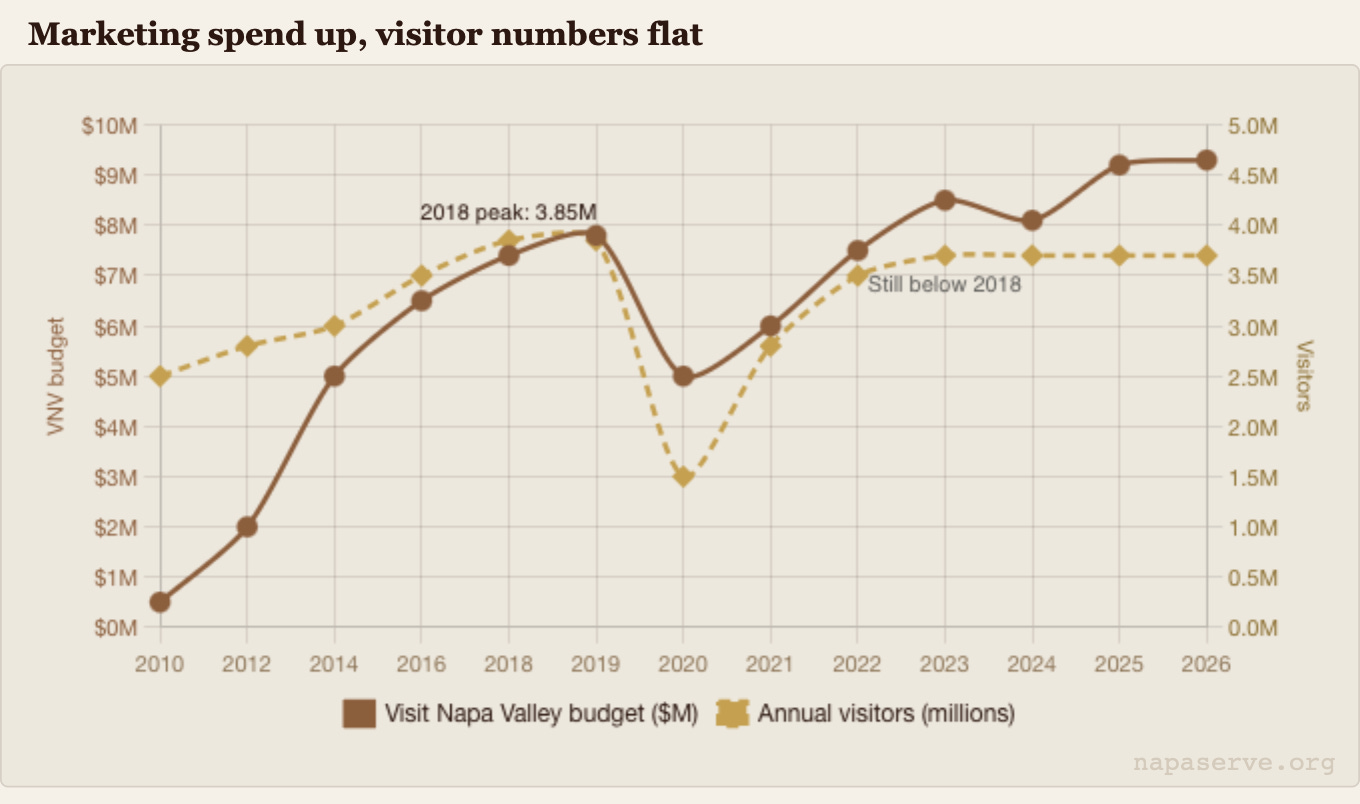
This piece examines two decades of escalating marketing spend in Napa Valley — Visit Napa Valley, Napa Valley Vintners, the Grapegrowers and Farm Bureau, the city visitor bureaus and individual winery hospitality and direct-to-consumer programs. Conservatively, the wine and hospitality industries have spent between $1.3 billion and $2.9 billion marketing Napa Valley over the past 20 years, with a mid-range estimate near $3.2 billion. The annual apparatus today runs above an estimated $200 million. The data on what that spending has produced — visitor count flat since 2018, occupancy below 2019, Napa County population declining and aging, vineyard contracts walking away, family estates passing to conglomerates, vineyard acres being pulled at scale — describes a region whose brand has migrated from Bentley scarcity toward Mercedes ubiquity. Mercedes is an excellent vehicle. It does not have Bentley cachet.
NEW:
This edition of Under the Hood is also published at NapaServe — Napa Valley Features' new community intelligence platform for Napa County. The interactive version includes hover-enabled data charts, a GDP-impact calculator for modeling the economic scenarios in this piece and additional reader polls. The site also features interactive dashboards and archive and event search. Read the interactive edition here.
We Need Your Guidance
This month Napa Valley Features enters its fourth year. Under the Hood started simple: one chart, one argument, a few hundred words built around the data. Roughly 100 columns later, the work has grown. The data is denser. The connections across wine, hospitality, real estate, labor, demographics and capital have multiplied. The columns now run thousands of words, with multiple charts, an interactive calculator on NapaServe, sourced footnotes, related coverage, methodology notes and a dashboard refresh — plus the recurring features each week: the Precision Puzzle, What We’re Reading, Visuals That Caught Our Eye and the rolling reader poll results.
We are planning to modify Under the Hood to include the main story plus reader polls, but before we do we ask that you weigh in. The poll below takes 10 seconds. The comment field is open if you want to say more.
The Challenges of Napa’s Massive Marketing Machine
By Tim Carl
NAPA VALLEY, Calif. — There is a way to think about brand equity that takes the shape of a luxury car.
Bentley sells roughly 10,000 cars a year worldwide. Mercedes-Benz sells about 2 million. Both companies make excellent vehicles. Both have decades of engineering credibility, deep dealer networks and recognized global names. Only one commands Bentley pricing and cachet. The reason has very little to do with the cars themselves and almost everything to do with what the brand is allowed to mean. Bentley protects its position with discipline — limited production, controlled distribution, a deliberate refusal to expand the audience past the point where scarcity erodes. Mercedes built a different model. It built reach. It built volume. It built a brand that means affordable luxury, prestige but not rarity. Both strategies are legitimate. Only one supports Bentley brand position.
Napa Valley spent the second half of the 20th century building Bentley brand equity. By the early 2000s the region was understood, globally and instinctively, as a place apart — a small agricultural valley producing rare wine, luxury accommodations and some of the world’s best restaurants for a small group of people who were in the know and could afford the price. The premium Napa Valley model was built on that perception. Land prices were built on the pricing model. The region’s economic identity was built on the land prices.
In the 20 years since, the wine and hospitality industries have spent in the billions of dollars marketing Napa Valley. The annual apparatus today runs above $200 million. The Tourism Improvement District that funds Visit Napa Valley was renewed last year through 2035, locking in another decade of escalating destination-marketing assessment on every overnight lodging stay in the county. By any measure, the spending has been enormous, sustained and well-executed.
The campaigns worked. Visitors came. Hotels were built. Tasting rooms multiplied. Programming diversified. By the metrics each individual campaign was designed to produce, the apparatus has been a success. What the apparatus did not protect — could not protect, given what it was being asked to do — was the underlying brand position. Each new campaign expanded the audience. Each expansion diluted the scarcity that supported the original pricing model. Two decades of escalating reach added up to something the apparatus did not intend and may not yet have reckoned with.
There is a deeper structural element. Napa Valley was built on the 1968 Agricultural Preserve, which enshrined agriculture as the highest and best use of the land — a phrase developers most often invoke to argue for the highest land pricing the market will support. Napa County is only 752 square miles, roughly 0.48% of California’s total area. The county produces about 4% of the state’s total wine but accounts for roughly 28% of California’s Type 02 winery licenses and generates approximately 27% of California’s wine industry retail value. And this is the rub. Marketing density and pricing density at this asymmetry is the architecture of the premium model itself.
The Bentley became a Mercedes.
This piece is about how that happened, what the spending math actually looks like and what the data now shows about whether the position can be recovered.
The Spending, Sourced and Stacked
The marketing apparatus has three tiers. Each is independently verifiable. Stacked, they reach into the hundreds of millions of dollars per year.
Tier 1: Trade and Destination Organizations. Visit Napa Valley’s fiscal 2026 budget is $9.3 million, up from $9.2 million in fiscal 2025 and $9.0 million in fiscal 2024 — figures the organization itself disclosed at its September 2025 destination symposium. That is a 1,500% increase from the pre-Tourism Improvement District era of 2010, when the organization operated on under $500,000. The TID assessment, a 2% surcharge on every overnight stay in Napa County, was renewed in 2025 for another 10-year term running through 2035. An additional $2 million in annual TID revenue stays with local jurisdictions — funding the City of Napa’s DoNapa marketing program, Calistoga’s destination programming and the marketing operations of Yountville, St. Helena and American Canyon. Total TID-funded marketing: $11.3 million annually.
Napa Valley Vintners, the region’s wine-industry trade association, files an IRS Form 990 each year showing annual revenue in the high single-digit millions. The Napa Valley Grapegrowers, Winegrowers of Napa County, the Napa County Farm Bureau and Collective Napa Valley each operate their own annual budgets. Combined, the trade-organization layer adds another $10 million to $12 million per year.
Tier 1 total: roughly $22 million to $23 million annually in trade and destination marketing alone.
Tier 2: Individual Winery Hospitality and Direct-to-Consumer Marketing. This is the larger figure and the harder one to pin down precisely. Industry analysts who track winery economics generally describe hospitality, club, paid placement and direct-to-consumer marketing as 8% to 15% of revenue at premium-positioned wineries. The number of active Napa wineries is itself disputed — the Napa Wine Project identifies more than 800 by name, other industry counts run above 1,000 once virtual brands are included, and many physical wineries operate second and third labels. Using a conservative subset of 500 active tasting-room operators and an average of $150,000 to $500,000 per operator in annual marketing-related spending, the layer runs $75 million to $250 million per year.
Tier 3: Hospitality, Lodging and Restaurant Marketing. Napa County has 5,400 hotel rooms, per Visit Napa Valley’s own reporting. Hotels, resorts and restaurants run their own marketing programs on top of the Tier 1 apparatus they fund through the TID. Conservative estimates put this layer at $30 million to $60 million annually.
Total annual apparatus, conservatively summed: $127 million to $333 million per year. Mid-range estimate: roughly $240 million.
Over 20 years, applied with a growth-curve adjustment that reflects the documented 1,500% TID expansion, the cumulative spend reaches between $1.3 billion at the most conservative floor and $2.9 billion at a mid-range estimate. The phrase “billions of dollars marketing Napa Valley” survives every assumption tested. Even the most aggressive haircut on the math leaves the cumulative figure above one billion.
For scale, comparing destination marketing organization to destination marketing organization: Napa’s Tier 1 trade and DMO spend of roughly $22 million to $23 million annually sits in the same neighborhood as Visit Anaheim’s ~$28 million annual budget for the 1,100-acre Anaheim Resort District anchored by Disneyland. The Las Vegas Convention and Visitors Authority operates a combined advertising and marketing budget of roughly $145 million annually, with another $70 million for special events — substantially larger than Napa’s DMO layer alone, but Las Vegas is a purpose-built destination economy of 41 million annual visitors. What is unusual about Napa is the totality of the apparatus across all three tiers. Including individual winery and hospitality marketing — spending the LVCVA and Visit Anaheim figures do not include — Napa’s full annual marketing apparatus runs at or above the LVCVA’s destination marketing budget, deployed in support of a 752-square-mile working agricultural region producing 4% of California’s wine.