Support Independent Local News:
Napa Valley Features depends on paid subscriptions to keep doing this work. We know this is a difficult time for many, but strong local news and information is more important than ever. As we continue the mission of Napa Valley Features, we are also building new tools and community resources that readers can explore at NapaServe.org. Please consider becoming a paid subscriber, renewing your subscription or joining as a founding member. We are now in our fourth year, and we could not do it without your support.

The Spotlight:
Welcome to Under the Hood, our exclusive weekly series for Napa Valley Features paid subscribers.
Summary of Today’s Article: With Northern California forecast for above-normal large-fire potential in July and August, Napa’s biggest vintage risk remains smoke exposure that can register months later as an ashy aftertaste rather than obvious damage in the vineyard. At the West Coast Smoke Exposure Task Force’s June 8 smoke summit, researchers described progress on the central problem: translating lab numbers into what tasters actually perceive, including the role of bound compounds that can release during aging or in the mouth. They also outlined faster screening tools and early findings on cellar remediation, while growers and insurers continue to spar over which markers are sufficient for claims and federal funding faces uncertainty amid USDA reorganization.
Beyond today’s discussion, we’re also digging into the latest results from our reader polls and pulling a few takeaways from our local economic dashboard.
You’ll also find a couple of recurring features in this edition: “What We’re Reading,” brief excerpts from recent articles offering a range of perspectives, and “Visuals That Caught Our Eye,” a closing roundup of standout charts and graphs from the week.
“What We’re Reading” — Excerpts of the Day:
Gerret van Sweringen Copeland, Delaware philanthropist, conservationist, art patron, wine industry leader and owner of Bouchaine Vineyards, died May 28, 2026, leaving a legacy of service, generosity and support for environmental, cultural and animal welfare causes. — Bouchaine Vineyards’ Gerret van Copeland Passes Away, Wine Business Monthly.
“There is absolutely nothing within the RMA [USDA Risk Management Agency] manual or the standards that says that those two markers must be present.” — Kristine Fox, director of crop insurance at Relation Insurance Services, in today’s Under the Hood.
"Today there are qualitative and quantitative signals that the steepest part of this correction is behind us." – from Rob McMillan, in "2026 Direct-to-Consumer Wine Report," Silicon Valley Bank.
"California’s $55 billion wine industry has been in crisis for three years, driven by record declines in American alcohol consumption, growing awareness of alcohol’s health risks and the increased popularity of wine alternatives such as hard seltzers." – from Susie Neilson, in "California wine giant Gallo announces another facility closure, layoffs," San Francisco Chronicle.
“I was there when my father, [Robert Mondavi], first presented the idea for a Napa Valley wine auction 47 years ago.” – from Tim Mondavi, in "Pouring it Forward," Wine Spectator.
“The (wine industry) has spent the past seven years or so denying that there’s an issue to face, and I don’t think you can fix an issue until you identify it or are willing to accept it.” – from Rob McMillan, in "One-third of Napa and Sonoma wineries report lowering their tasting fees amid tourism declines," San Francisco Chronicle.
“Gasoline and shelter up.” – from the Bureau of Labor Statistics, in "Higher gasoline prices likely pushed up US consumer inflation again in May," Reuters.
“Premiumisation remains a powerful long-term trend, with consumers increasingly choosing to drink less but better.” – from Sam Fischer, in "TWE to cut portfolio from 76 to 30 brands," Food&Drink Business.
“This milestone is the culmination of months of hard work and reflects our commitment to growth, expansion and investing in the future.” – from Tom Day, in "Reyes Beverage Group Closes Acquisition of Republic National Distributing Company's Operations in 11 Markets," Reyes Beverage Group.
“We're going to be attacking them, attacking them very hard.” – from President Donald Trump, in "Iran war live: Trump says Iran 'will pay the price' for taking too long to negotiate a deal," Reuters.
“This opens your eyes to a whole new way to think about people with diabetes, and getting good blood-sugar control without a new device or new machine.” – from Denise Faustman, in "TB vaccine from the 1920s shows promise in diabetes trial," Nature.
“Today we’re taking historic action to bring down the price of energy and the cost of living for all Americans with the power of clean, beautiful coal.” – from President Donald Trump, in "Trump Offers Funds for First New U.S. Coal Plants in 13 Years," The New York Times.
Smoke Taint Science Narrows the Lab-to-Palate Gap as Napa Braces for Fire Season
by Tim Carl
NAPA VALLEY, Calif. — The National Interagency Fire Center’s latest outlook calls for above-normal large-fire potential across Northern California by July and August, and live fuel moisture at higher elevations is already dropping. For Napa Valley’s vineyards, though, the number that matters most arrives later in the season, and it is not measured in acres burned. Since 2020, the dominant threat to the region’s vintages has not been the flame front but the smoke behind it — volatile compounds that settle invisibly into grape skins and surface months later as an ashy taste in the glass.
That shift was the throughline at the West Coast Smoke Exposure Task Force’s annual smoke summit on June 8, a two-hour virtual program that drew federal researchers, university scientists, an insurance specialist and growers from across California, Oregon and Washington. Alisa Jacobson, who chairs the task force’s research committee, guided the program and framed its purpose as turning that science into practical guidance for growers — the sampling and small-scale fermentation protocols and the frequently asked questions the committee keeps up to date. Jacobson also owns Turning Tide Wines, a climate-focused label built on organic and regenerative farming. The picture that emerged this year is of a field closing in on its longest-standing uncertainty — the gap between what a lab can measure and what a taster can perceive — even as the federal money funding that work moves through an uncertain restructuring and the crop-insurance system meant to backstop growers stays a step behind the chemistry.
What the Science Can Now Measure
For all the chemistry involved, the researchers kept returning to a single sensation: the ashy aftertaste. It is the most consistent and most persistent marker of smoke exposure, and it presents in the mouth before it can be detected by smell.
“The ashiness presents in mouth first,” said Elizabeth Tomasino, a professor of enology at Oregon State University whose work focuses on flavor chemistry and sensory perception.
Arran Rumbaugh, a chemist with the USDA Agricultural Research Service in Davis, reported that even low levels of exposure can mute a wine’s fruitiness and introduce a faint ashy character on the palate, while higher exposures produce the overt smoky, ashy flaws growers fear. The aftertaste takes time to emerge — roughly 30 seconds after a wine is tasted or swallowed — and can linger 90 seconds to two minutes, which is why tasting protocols now call for patience and a thorough rinse between samples to avoid false positives.
The harder problem is interpretation. A wine can test below published thresholds in the lab and still taste ashy on the palate, a mismatch that has frustrated growers for years.
“Take that threshold number with a grain of salt,” Tomasino said.
Part of the explanation is that free smoke compounds are only part of the story. Sugar-bound versions of the same compounds, called glycoconjugates, can release during aging or even in the mouth, where saliva enzymes break the chemical bonds. Tomasino said her current guidance is to treat the relevant marker as a total — free plus bound guaiacol — rather than the free value alone, a recommendation about six months old. The field’s reference points trace to a 2012 study by Mango Parker and colleagues at the Australian Wine Research Institute, which puts guaiacol’s sensory threshold at 23 micrograms per liter in red wine, with related cresols ranging from about 20 to 65 and syringol far higher and less consequential. Complicating matters further, guaiacol and 4-methylguaiacol also form during oak-barrel toasting, so their mere presence does not prove smoke exposure. Sensory thresholds, Tomasino added, are typically set at the level half a population can detect; because ashiness is so disliked, she and some colleagues now report thresholds at 75% to 80% detection, which lowers the number.
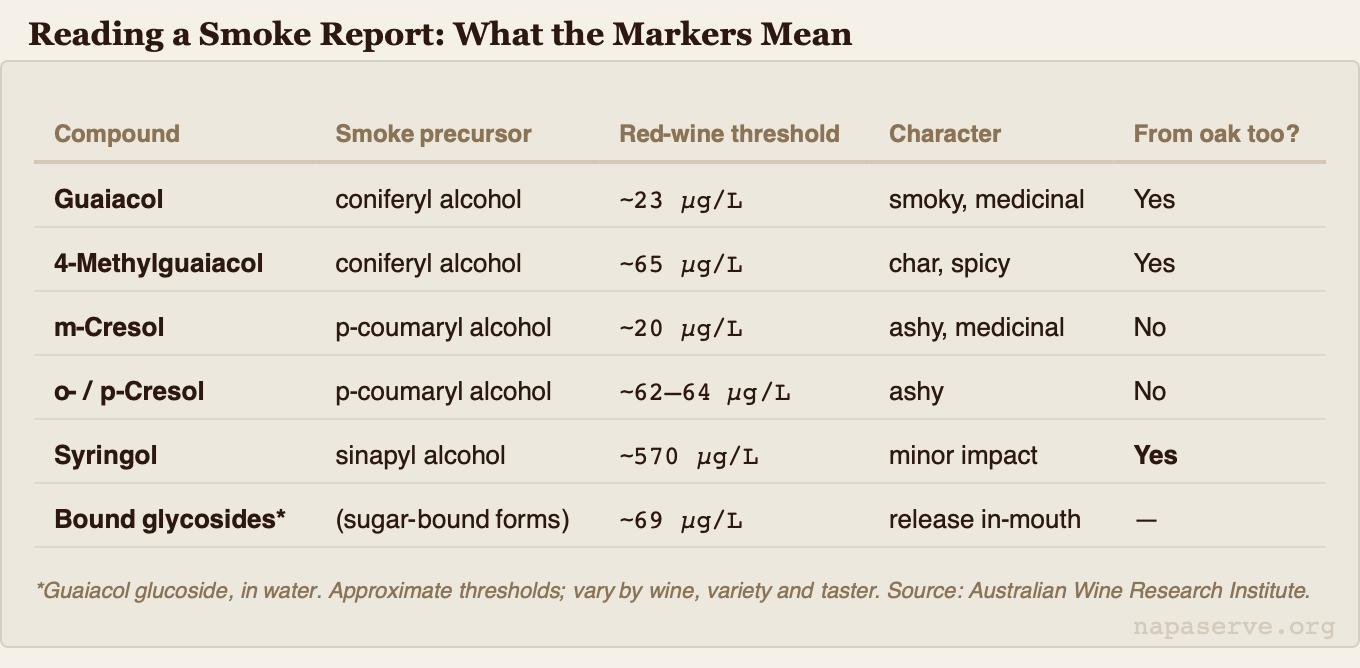
Cole Cerrato, who runs Oregon State University’s Smoke, Wine, and Grapes Analytical Chemistry Lab, traced the compounds to their source: lignin in the burning fuel — bark, brush and grasses — which breaks down under fire into guaiacol and 4-methylguaiacol, the cresols and syringol. He noted that grape variety drives much of the variation in how grapes absorb and express these compounds — in current trials, syrah has proved relatively resistant and pinot noir more sensitive. Researchers also described a newer class of compounds, thiophenols, that appears to contribute to the lingering ashy finish and that several labs are still developing methods to measure.
One advance could shorten the wait for answers. Rumbaugh said researchers are working with a chemical-fingerprinting device that reads the headspace above a wine and can distinguish smoke-impacted samples in about five minutes, and that a baseline database being built with UC Davis and an industry partner — carrying on Anita Oberholster’s work on background levels in grapes and wines — should be accessible by next season, giving growers a reference point to compare suspect samples against.
The Money Behind the Microscope
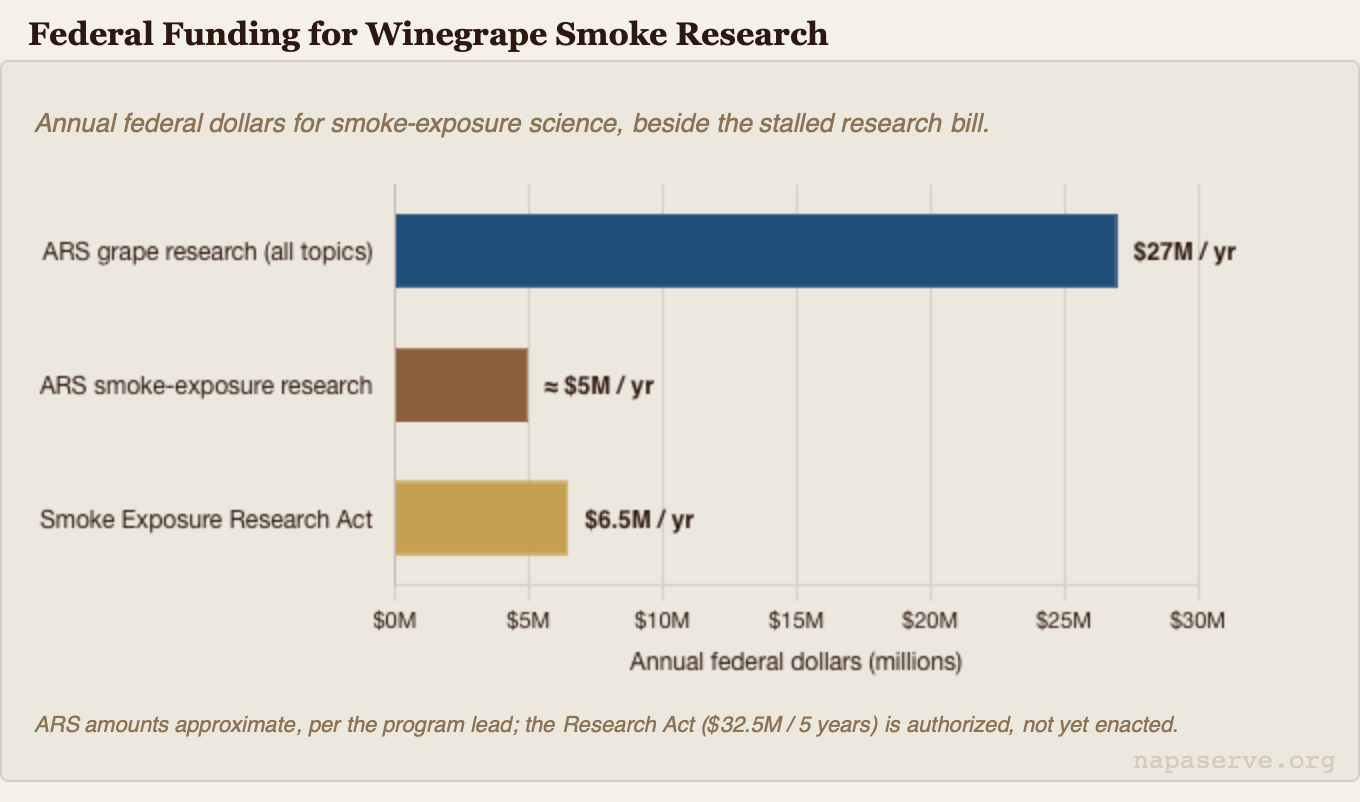
Much of this research is federally funded, and that funding has been turbulent. At the task force’s 2025 summit, Tim Rinehart, the ARS national program leader who oversees the work, described an agency grape-research portfolio of about $27 million a year, of which roughly $5 million is directed to smoke exposure in wine grapes — money appropriated by Congress and shared with UC Davis, Oregon State and Washington State. He reaffirmed the roughly $5 million annual smoke figure at this year’s summit.
Earlier in 2025, federal staffing cuts briefly reached the smoke taint program itself. Rumbaugh and other ARS grape researchers were among those terminated before the cuts were reversed.
The agency is also reorganizing. USDA announced a department-wide restructuring in July 2025 that includes closing the Beltsville Agricultural Research Center in Maryland and relocating much of its Washington-area workforce to five regional hubs, a plan it reaffirmed in April 2026. Rinehart told this year’s summit that the restructuring carried roughly $32 million in congressionally directed project terminations across ARS — about $20 million of it at Beltsville — though he said grape researchers were not directly affected, and pointed to fiscal 2027 House budget language that named smoke exposure research and set aside $715,000 for it.
That in-house ARS work is separate from the proposed Smoke Exposure Research Act, the bipartisan bill described in “Wine Chronicles: Napa Braces for the 2025 Fire Season,” (June 5, 2025). Reintroduced in 2025 by Sens. Alex Padilla and Jeff Merkley and Reps. Mike Thompson and the late Doug LaMalfa, the bill would authorize $32.5 million over five years — $6.5 million a year from fiscal 2026 through 2030 — for dedicated smoke research at the three land-grant universities. One stream funds the federal scientists through annual appropriations; the other would create a separate, longer-term authorization. Both run on the same uncertain political clock.

In the Vineyard, Few Sure Tools
If the science is sharpening, the toolkit available to growers before harvest remains thin. Tom Collins, an associate professor at Washington State University who first worked with smoke-affected fruit in California in 2008, said timing offers less protection than many growers assume. Fruit exposed well before veraison — in some trials as early as the end of bloom — still produced smoke-affected wine, meaning early-season smoke cannot be dismissed.
Proximity is also an imperfect guide. Smoke ages as it travels, with gas-phase compounds breaking down within hours and particles settling out over distance, so faraway fires sometimes cause damage and sometimes do not.
Washing offers little help and can backfire. Collins said the marker compounds embed inside the grape skin, where rinsing does not reach them, and that washing a canopy without first removing leaves can drive ash into the clusters and raise compound levels. Barrier sprays carry a similar trap: Kaolin and bentonite work by adsorbing compounds from the smoke, but Collins said that if they are not rinsed off after the smoke clears, they can release those compounds back into the fruit — leaving it worse off than if nothing had been applied.
Newer functional coatings under study at Oregon State show more promise, but their effectiveness varies by compound. For now, Collins pointed growers toward small-scale risk assessment — bucket fermentations of 10 to 20 kilograms of fruit, or smaller “nano” ferments in canning jars held at temperature — which allow a grower to smell and taste a sample about a week before harvest and to freeze a portion for later lab testing. He recalled the bottleneck of the 2020 season, when fires up and down the West Coast overwhelmed the certified labs.
“Lab capacity was challenged — that’s very diplomatic for what it was,” he said. “It was just impossible to keep up with the number of samples.”
In the Cellar, Subtraction at a Cost
Once smoke-affected fruit reaches the winery, the question becomes what can be removed. Torey Arvik, a research food technologist with ARS, described an early head-to-head comparison of four commercial remediation technologies run over three days, generating dozens of samples for analysis. Reverse osmosis paired with carbon and a proprietary ultrafiltration process produced the steepest reductions in volatile smoke compounds, he said, though reverse osmosis appeared to raise the bound, glycosylated forms, and one polymer showed little measurable effect. The comparison is preliminary, part of a study that runs through 2028.
The test wine came from close to home. The 2025 Pickett Fire ignited Aug. 21 near Calistoga, burned 6,819 acres mostly within the footprint of the 2020 Glass Fire and threw smoke across Napa, Sonoma and Solano counties. Arvik said a backfire lit beside a premier Napa Valley cabernet vineyard during that fire yielded fruit whose research wine ranked, by his account, among the most heavily smoke-affected wines ETS Laboratories in St. Helena had measured.
To make the wine practical to study and potentially salvageable, researchers blended it down to a roughly 35% smoke-affected, 65% less-affected mix before treatment — a reminder that even the most aggressive cellar fixes work best on fruit that is not heavily tainted to begin with. Further out, ARS teams in Albany are pursuing genetic approaches: One group has identified bacterial genes that break guaiacol down into compounds already present in wine and hopes to engineer a wine yeast that carries them, while a lab led by Roger Thilmony uses microvine models and gene editing to interrupt the glycosylation that locks smoke compounds into the grape itself. None of it amounts to a single fix.
Insurance Plays Catch-Up
The financial backstop is evolving on its own track. Kristine Fox, director of crop insurance at Relation Insurance Services in Fresno, walked through the federal Fire Insurance Protection-Smoke Index endorsement, which the Risk Management Agency introduced for California grapes in the 2025 crop year and expanded to Idaho, Oregon and Washington for 2026. Rather than insuring an individual vineyard, it stacks on a grower’s multi-peril crop-insurance policy and covers part of that policy’s deductible when a county records enough heavy-smoke days, drawing on federal smoke-mapping data rather than vineyard testing. It runs from June 1 to Nov. 10 regardless of whether a crop has been harvested, considers no individual vineyard yields, requires no lab testing or notice of loss and pays automatically after the insurance period once federal officials release the list of triggered counties. Because it tracks county smoke rather than a single fire, it does not distinguish wildfire smoke from a controlled burn. Fox said the county threshold runs to 13 heavy-smoke days, after which the payout rises with each additional smoky day.
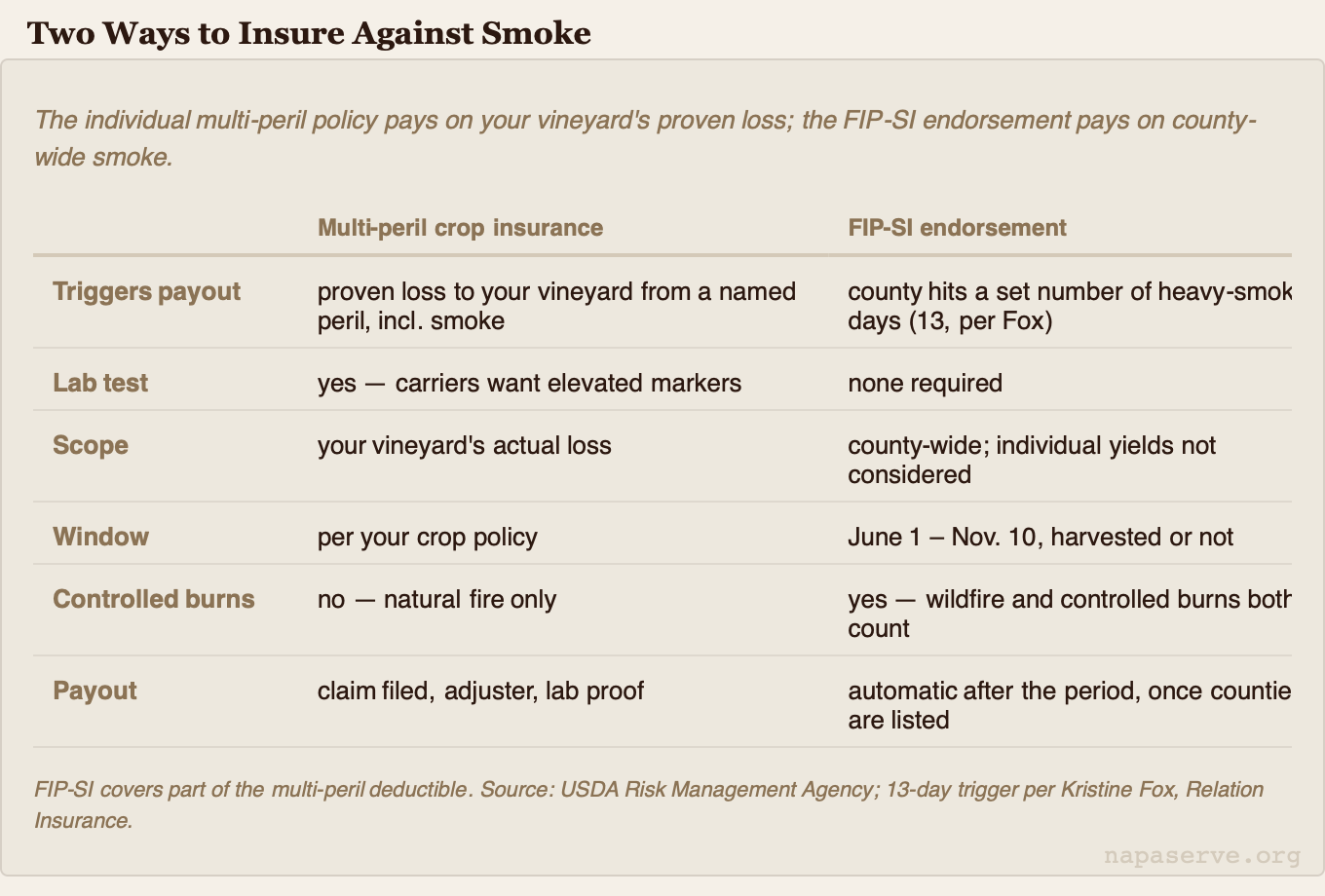
The older multi-peril policies are where Fox flagged a growing problem. Insurers, she said, increasingly want lab reports showing elevated levels of both guaiacol and 4-methylguaiacol before paying a smoke claim, and growers whose reports show other elevated smoke markers instead have seen claims rejected.
“There is absolutely nothing within the RMA manual or the standards that says that those two markers must be present,” Fox said. “They just say that there must be elevated markers of smoke.”
Her advice to growers facing that gap was procedural: push back through an agent, keep blocks separate and uncommingled, document every attempt to market the fruit and save frozen samples in case a claim requires them later.
Video: Nichelini Family Winery in the aftermath of the 2020 Hennessey Fire — Tim Carl Video
What to Watch
The result is a season that opens with the same structural mismatch the smoke era has produced every year. The detection science is finally narrowing the gray area between a number and a flavor, but the most reliable answer still comes from tasting a small fermented sample a week before harvest. The cellar tools can subtract smoke compounds, but only within limits and at the cost of some of what makes the wine. The funding that drives the research is sound enough to claim progress and unsettled enough to leave next year’s budget in doubt. And the insurance system is still arguing over which molecules count.
The logic Napa County has applied on the ridgelines — described in “Napa County’s Newest Ridgetop Firebreak, Built Parcel by Parcel,” (May 20, 2026) — runs in two directions here. Holding a fire small on the Mayacamas crest keeps flames off the structures below, and it can help keep smoke off the valley floor and out of the fruit. The open question for the 2026 vintage is the same one that has defined the smoke era since 2020: whether the science, the money and the policy can close the distance to the fire line before the next fire arrives to test them.
—
Tim Carl is a Napa Valley-based photojournalist.
Today’s Polls:
Recent Poll Results:
In Tim Carl’s article “Friday E-dition: A Generation Comes Home to Tell Napa’s Other Story,” four longtime Napa farming families premiered the short film “Napa As It Was” at Robert Biale Vineyards and used the event to argue that headlines about wine’s decline overlook a parallel story of commitment and return. The evening centered on multigenerational farming roots, the legacy of the 1968 Agricultural Preserve and a new wave of next-generation leaders moving home to take over family operations amid vineyard pullouts and economic uncertainty. The reader polls that follow echo the tension between optimism and realism: respondents are split on whether Napa can regain prior market strength, most do not believe Gen Z will out-earn their parents and many see the economy as the biggest force shaping Napa’s next decade.
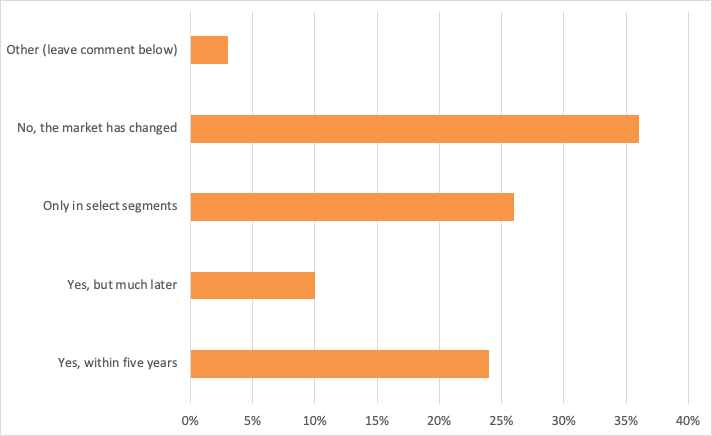
Question: Will Napa Valley wine regain its 2018 market strength?
Summary: Outlook for Napa Valley wine returning to 2018 strength. A plurality says the market has changed (36%) while 26% expect recovery only in select segments. Optimism is present but divided with 24% expecting a rebound within five years and 10% expecting it much later while 3% chose other. Total responses: 58.
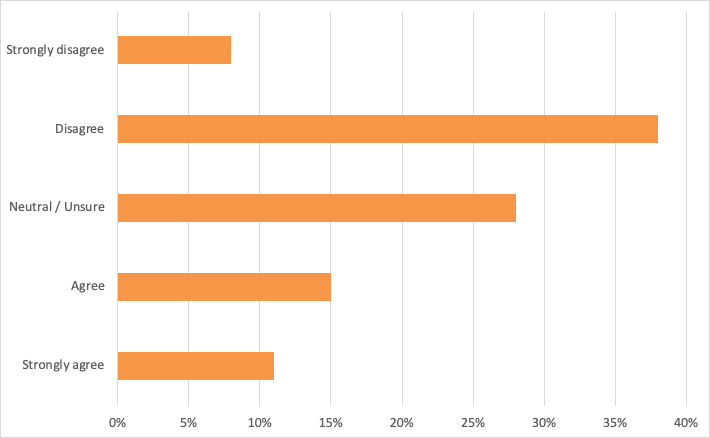
Question: Statement: Gen Z will earn more than their parents over their lifetimes.
Summary: Expectations for Gen Z lifetime earnings relative to their parents. Most respondents disagree (38%) or strongly disagree (8%) while 15% agree and 11% strongly agree. A sizable share is neutral or unsure (28%). Total responses: 53.
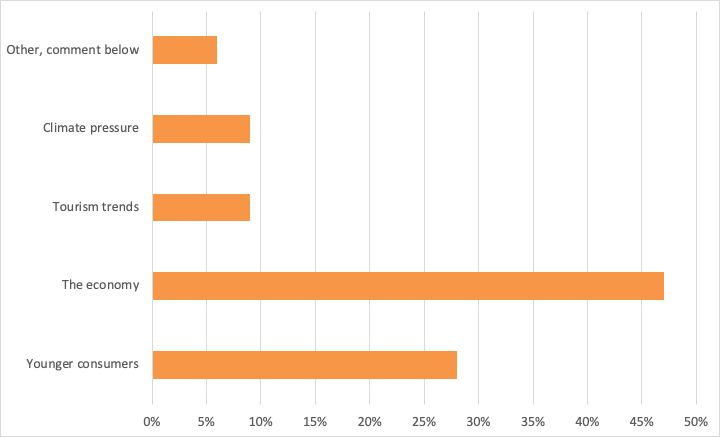
Question: What will most shape Napa Valley wine’s next decade?
Summary: Factors expected to shape Napa Valley wine over the next decade. The economy leads decisively at 47% followed by younger consumers at 28%. Tourism trends and climate pressure each register 9% and 6% selected other. Total responses: 53.
The Economy:
NEW: Visit our new Community Dashboard to get the most up-to-date information.
Economic Pulse Indicators Local:
Key Local Takeaways:
Napa County’s unemployment rate was down in April to 4%.
Winery license issuance is largely flat after the biggest drop in history.
Napa home values remain down, sales are largely flat MoM.
The Local Data:
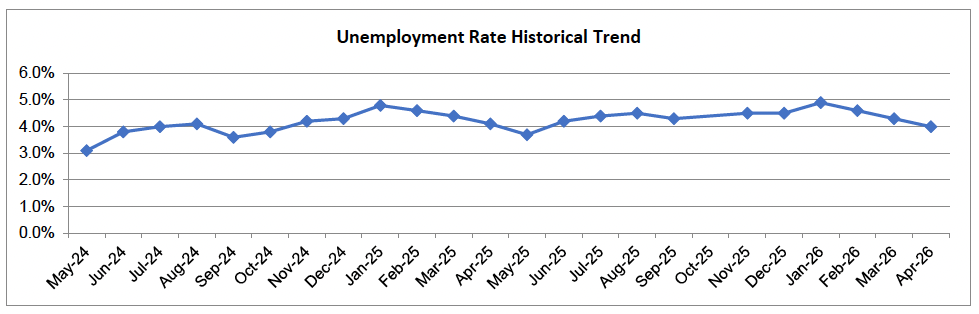
Napa County’s unemployment rate fell to 4% in April as total employment rose 2.5% year over year, led by gains in leisure and hospitality, manufacturing and health services. (Source)
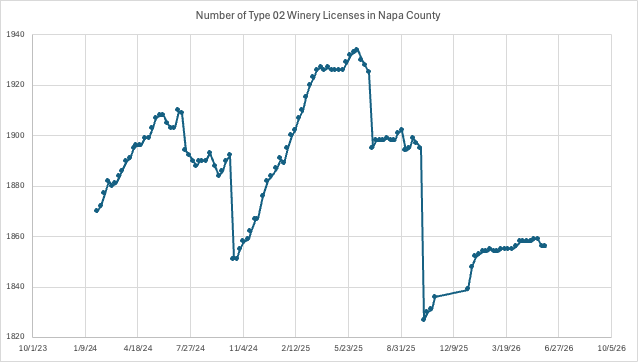
As of June 2, Napa County had 1,856 Type-02 winery licenses, which was down three from last week. (Source)
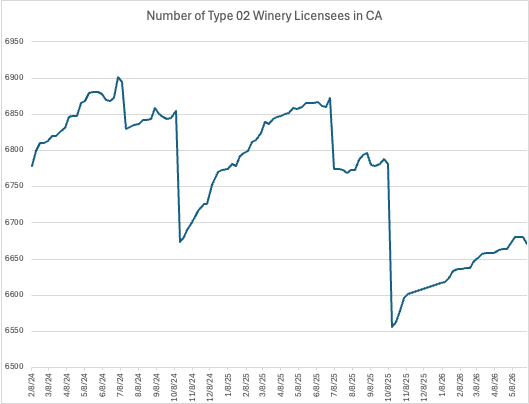
As of June 2, California has 6,671 Type-02 winery licenses, which was down nine from last week. (Source)
Napa County’s civilian labor force fell about 4.1% year over year to roughly 72,000 in January 2026, remaining below its October 2008 peak of 79,289 and above its January 1991 low of 54,355. (Source)
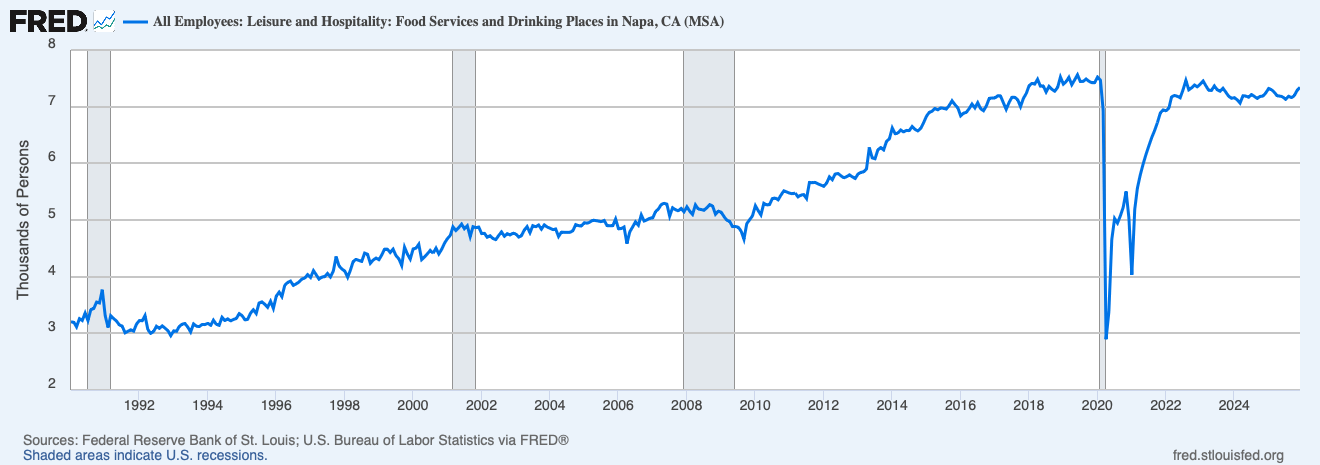
Employment in Napa County’s food services and drinking places sector was about 7,339 in December 2025, roughly 3% below the June 2019 peak of 7,589. (Source)
As of June 2, the average Napa County home value is $893,351, which is down 3.2% year over year, while homes go pending in 37 days. (Source)
Visuals That Caught Our Eye:
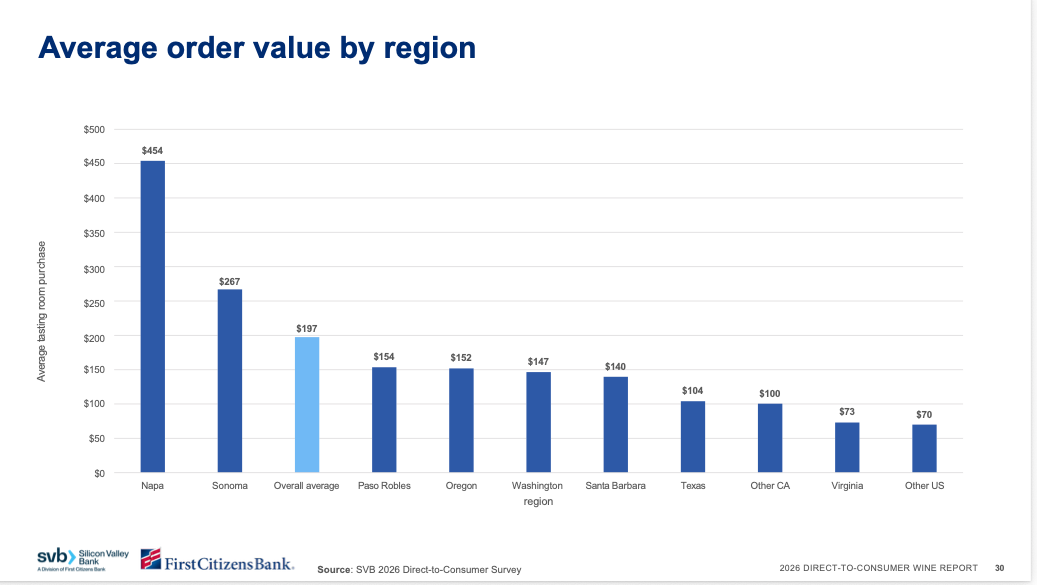
Average tasting room order values also showed wide regional differences in 2025, with Napa wineries generating the highest average purchase at $454 per visitor, followed by Sonoma at $267, while other U.S. regions averaged $70. (Source)
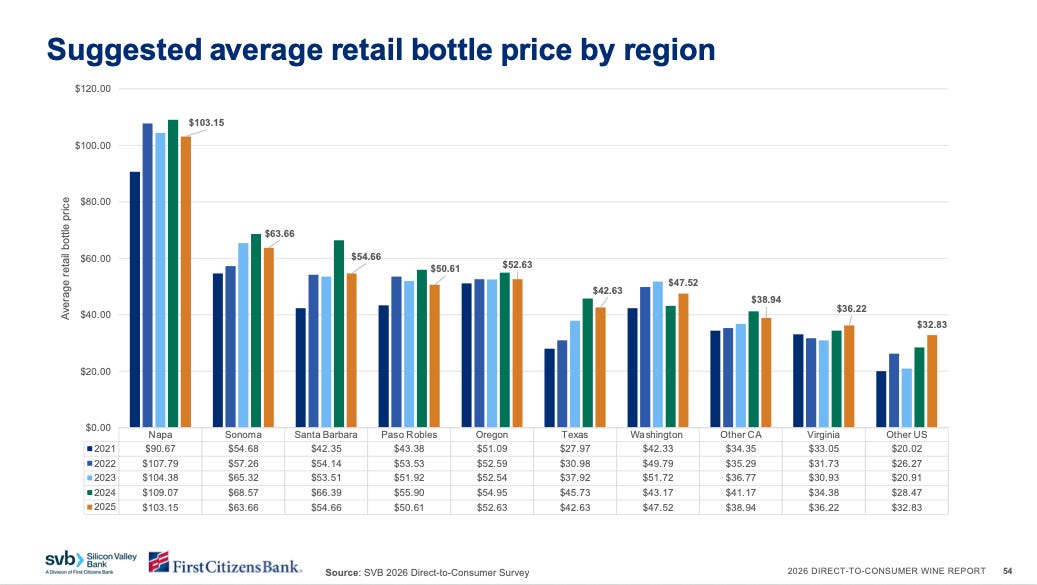
Average suggested retail bottle prices varied significantly by region in 2025, with Napa wineries leading at an average of $103.15 per bottle, followed by Sonoma at $63.66 and Santa Barbara at $54.66, while other U.S. regions averaged $32.83. (Source)
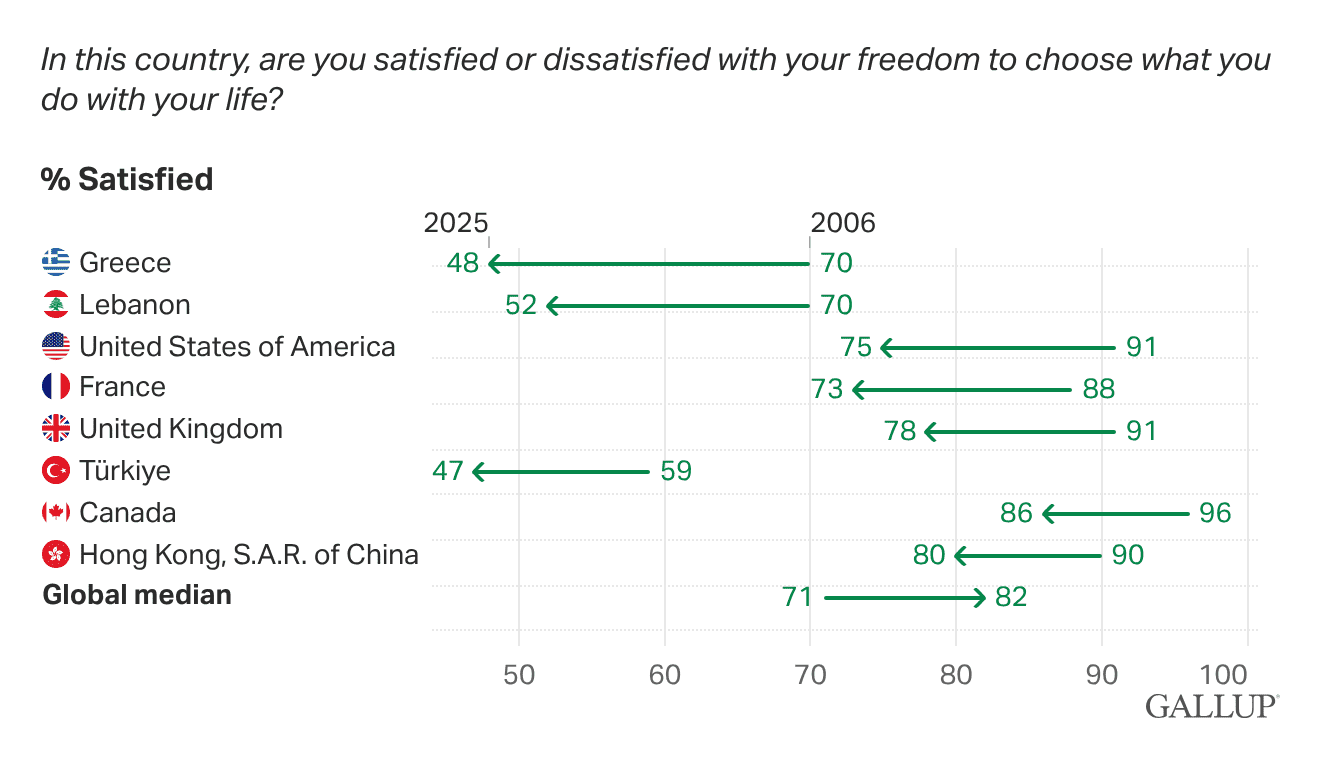
Four of the eight countries with the steepest declines in satisfaction with the freedom to choose what they do in life over the past two decades are G7 members. (Source)
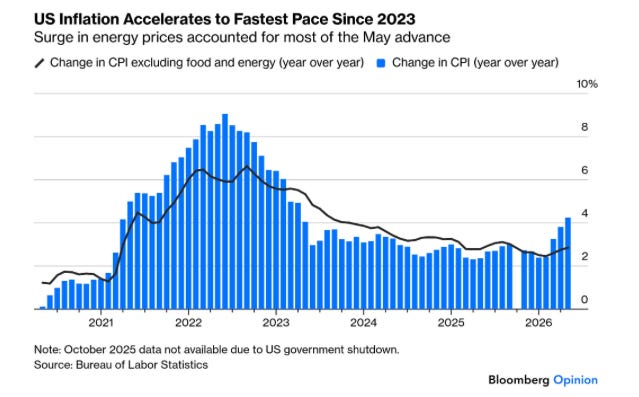
Inflation is the worst it’s been in three years. (Source)
Explore These Related Articles:


Browse All Napa Valley Features Stories
Browse All Sonoma County Features Stories
Browse All Lake County Features Stories
—
The views, opinions and data presented in this article are those of the author and do not necessarily reflect the official policy, position or perspective of Napa Valley Features or its editorial team. Any content provided by our authors is their own and is not intended to malign any group, organization, company or individual.